You have written a good first email. Now the awkward question: how many times do you follow up before you look desperate, and how many times before you have simply not been noticed?
The honest answer for small B2B teams is three to five emails in total, spread over two to four weeks, each one carrying something new. That range is not a magic number. It is the result of two forces pulling against each other: the prospect’s inbox is busy and one email rarely lands at the right moment, but every extra message spends a little of your domain’s goodwill and the prospect’s patience.
This article walks through how to set the number of steps, how to space them, what each step should do, and how to stop cleanly. It also explains how a sequence tool should behave when someone replies halfway through, because the wrong behaviour there does more damage than any choice about length.
What a follow-up is for
A follow-up is not a reminder that you exist. It is a second attempt to land at a moment when the prospect can act. People do not reply to a good email because it is good; they reply because it arrived on a day when the problem it names was on their mind and they had four minutes to spare.
That framing changes the design. If each step is a fresh attempt at good timing, then the steps should be spaced to cover different weeks and different states of mind, and each one should stand on its own. Someone who deleted step one without reading it should be able to understand step three.
It also tells you when to stop. Once you have covered a reasonable window of the prospect’s calendar, more messages are not more chances at timing; they are the same chance repeated at a person who has now seen you several times and chosen not to act.
The range: three to five messages
Here is how the steps usually shape up in practice.
Step 1, the opener. Your best case for a conversation in as few words as possible. One observation about their company or role, one sentence on what you do, one easy question.
Step 2, two to four working days later. Short. Sits in the same thread. Adds one new piece of context: a concrete example of the outcome, a relevant detail about their industry, or a sharper version of the question. Do not repeat the opener.
Step 3, about a week later. A different angle. If the first two spoke about a problem, this one can speak about a decision they may be facing, or ask who else in the company owns the topic. In account-based outreach this is often the step where you say you are also speaking to a colleague, if that is true.
Step 4, another week or so later. Optional. A low-effort ask: a single yes or no question, or an offer to send a short document instead of asking for time.
Step 5, the close. A one- or two-line message saying you will stop here, and that they are welcome to reply whenever the topic becomes relevant. This is the step that many teams skip and should not.
Three steps is the floor for a cold list. Below that, you are betting the whole campaign on one or two moments of timing. Five is a sensible ceiling for people who have never heard of you. If you find yourself writing step six, ask what step six knows that step five did not.
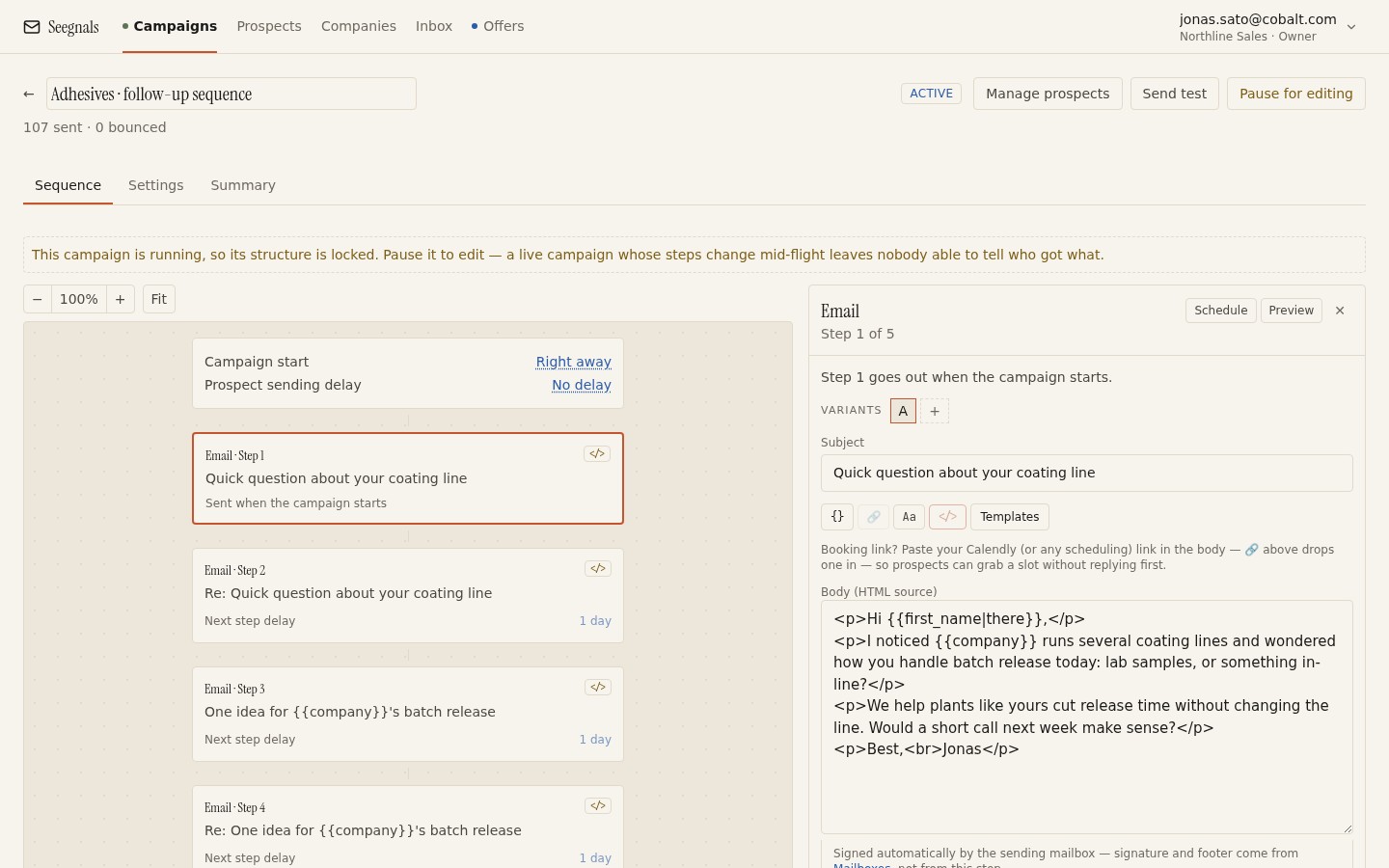 A five-step sequence in the editor: the delays widen as the sequence goes on, and each step carries a different message rather than a repeat.
Spacing: widen the gaps as you go
The first gap should be short, two to four working days, because the opener is still fresh in the thread and a quick nudge reads as natural. After that, widen to around a week. A prospect who was on holiday, at a trade show or buried in quarter-end will surface within that window, and a sequence that spans three or four weeks crosses at least one of those events.
Two practical notes on spacing:
- Count in working days. A follow-up that lands on Saturday morning sits under Monday’s pile. Your sending tool should let you set weekdays and hours per campaign; it is also worth sending in the prospect’s own timezone so that “Tuesday morning” means their Tuesday morning.
- Randomise the exact moment. If every step fires at exactly 09:00, the pattern is visible to mail providers and to anyone who receives two of your campaigns. Seegnals randomises the gaps between individual messages within the window you set; the schedule is a window.
Every step needs a reason
The most common failure in follow-ups is the empty bump: “Just checking whether you saw my last email.” It contains no information, it asks the prospect to do the work of scrolling up, and it signals that you have nothing else to say.
A simple test for each step: if the prospect only ever read this one message, would they know who you are, why you wrote, and what you want? If the answer is no, the step is not finished.
Some honest sources of new content for a follow-up:
- A different consequence of the same problem (cost in step one, time in step two).
- A concrete, checkable example of what your product does, without a made-up client name.
- A question about who owns the topic internally.
- A change in the ask: from a call to a two-line reply, from a reply to a document.
- A reference to something the company itself has published, if you can quote it accurately.
What does not count as new: a bigger claim, a discount, or a longer version of step one.
Stop the moment anyone replies
A sequence is a bet on silence. The instant a prospect replies, the bet is settled, and any further automated step is a mistake. This sounds obvious, yet it is the single most frequent embarrassment in outbound: someone writes “not now, thanks” and receives step four the following Tuesday.
It also applies to replies that are not from the prospect. An out-of-office message tells you the timing is wrong; keep sending and you have wasted the remaining steps on an empty desk. A bounce tells you the address is dead. A colleague answering on their behalf tells you the conversation has moved.
Seegnals handles this by classifying every incoming reply (Interested, Maybe later, Not interested, Autoreply / Out of office, Bounce, Unsubscribe request, Other) and stopping the sequence for that person as soon as a reply is classified. You can reclassify in one click if the classifier got it wrong. There is more on what to do with autoreplies and on sorting Interested from Maybe later elsewhere on this blog.
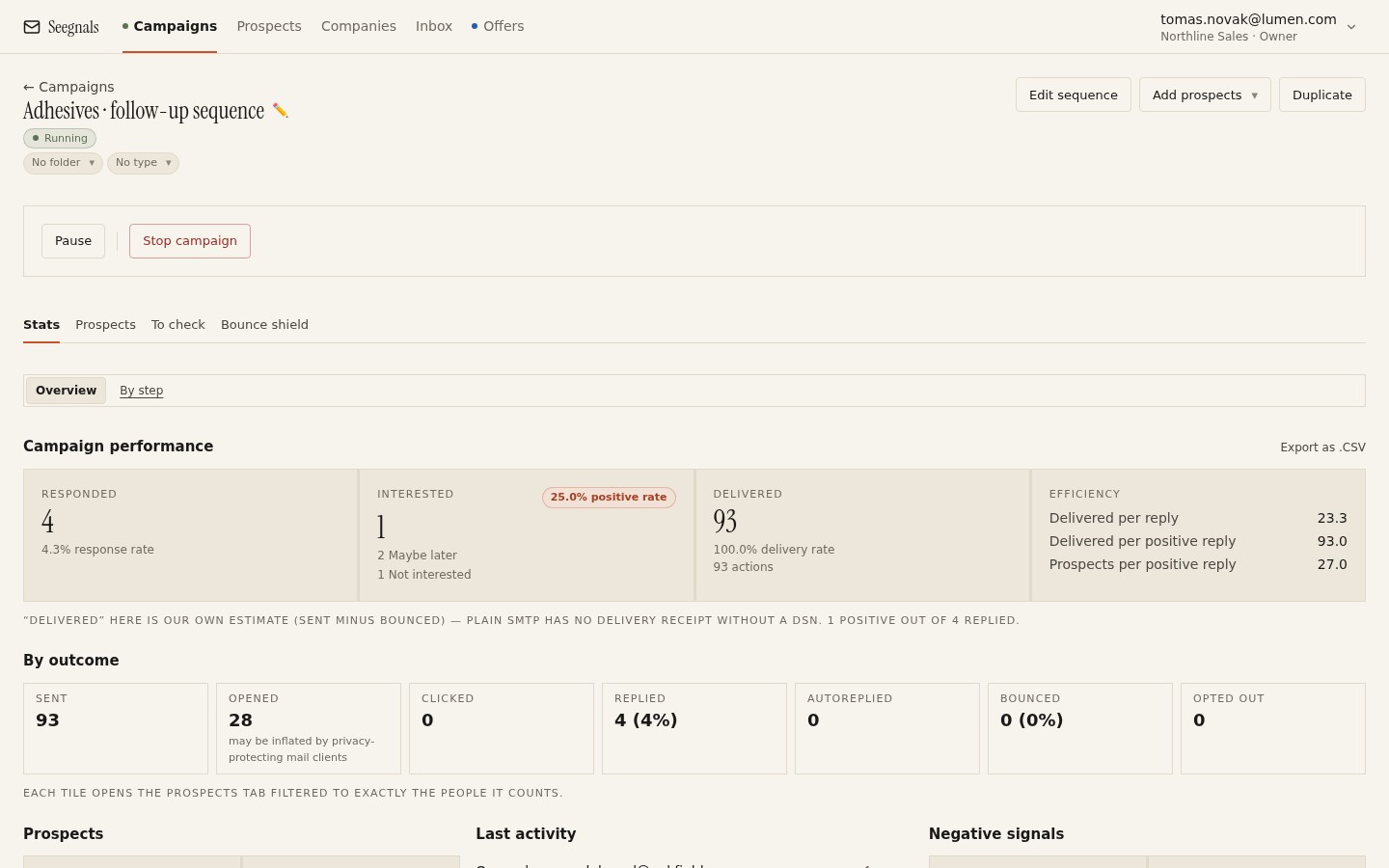 The Stats tab shows Replied, Autoreplied and Bounced as separate outcomes, so you can see how many sequences stopped for each reason rather than one blended number.
Reading the numbers by step
Once a campaign has run its course, look at the per-step breakdown rather than the campaign total. You want to know two things.
First, where do replies arrive? If most of the positive replies come from steps one and two and step four produces almost nothing but unsubscribes, the sequence is too long for this segment. Shorten it. If step three regularly produces replies, the widened gap is doing its job.
Second, where do the negative signals cluster? Unsubscribes and “not interested” replies that pile up on a specific step usually point at that step’s copy rather than at the sequence length. Rewrite the step before you cut it.
Because a replied prospect counts as done in the campaign progress bar even if later steps never send, a campaign can reach Done while a third of the people never saw step five. That is the intended outcome: the sequence ended early for them because it worked.
Length is a per-segment decision
Do not settle on one sequence length for the whole company. A list of warm-ish contacts who downloaded something from you can take a two-step nudge. A cold list of plant managers in another country may need the full five steps to cross a language barrier and a holiday. A list of senior executives deserves fewer, better-written steps and a faster stop.
Build one campaign per segment, give each its own step count and timing, and compare them in the campaigns list. Templates are for copy.
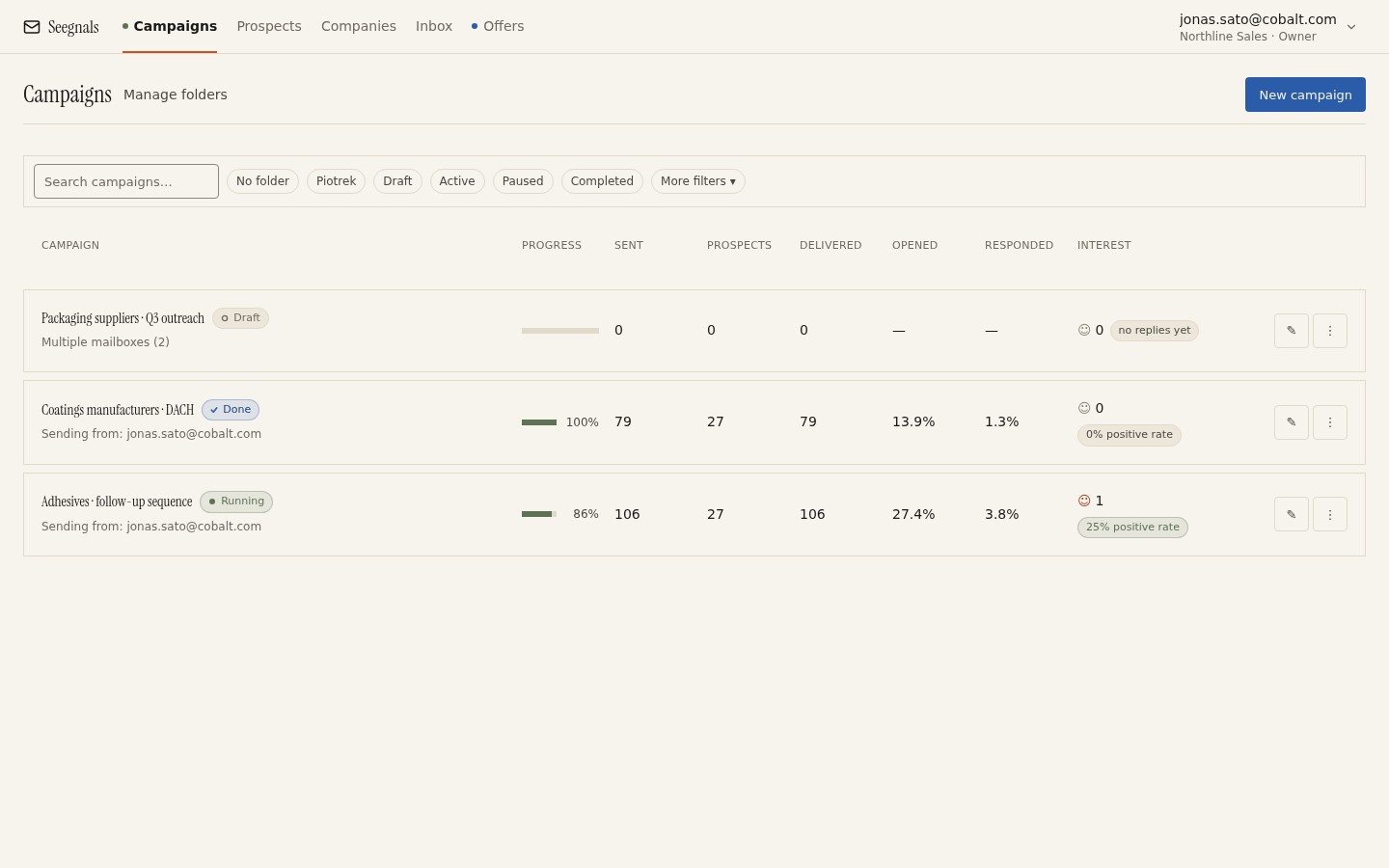 Running one campaign per segment lets you compare a three-step sequence against a five-step one on the same list, side by side.
What to do this week
- Open your current sequence and read each step on its own, as if it were the only message the prospect ever saw. Rewrite any step that does not stand alone.
- Set the gaps: two to four working days after the opener, then roughly a week between later steps, with weekdays and hours restricted to the prospect’s working time.
- Add a short closing step if you do not have one, and make sure it says plainly that you will stop.
- Check that any classified reply, including out-of-office and bounces, stops the sequence for that person. If your tool does not do this, do it manually before every send day.
- After the campaign finishes, open the per-step statistics and decide whether the next version of this segment’s sequence is shorter, longer, or the same length with one rewritten step.