Type “best time to send cold email” into a search engine and you get a confident number: Tuesday at 10am, or Thursday at 2pm, depending on which article you land on. The numbers disagree with each other because they are built the same way, by averaging results across companies that sell different things to different people through different lists. The average tells you about the average company. It does not tell you about yours.
The honest answer is less exciting and more useful. There is no universal best hour. What predictably matters is sending within the recipient’s own working day, in their own timezone, spread across a window wide enough that no single message depends on hitting a magic slot. Get that right and the rest is closer to noise than to a rule you can look up.
This article explains why the “best hour” claims do not transfer to your list, what to set instead, and how a sending schedule should behave when you do not know exactly where a prospect sits on the map.
Why “best time” studies do not transfer to your list
A study that claims a best hour has to have averaged across many campaigns to get a number at all. Averaging throws away the thing that actually decided each reply: whether the message was relevant to that person, whether it arrived when they had a spare minute, and whether their mailbox trusted the sender enough to show it in the primary inbox rather than a promotions tab or a spam folder. None of that is a property of the clock.
Your list is not the average. If you sell to finance teams, their quiet minutes fall differently across the week than a marketing team’s do. If you write to plant managers in DACH, their working day and their attention pattern have nothing in common with a study built from software buyers in North America. A headline hour borrowed from someone else’s list is a guess wearing a number.
The timezone is the part that actually travels
One claim from the folklore does hold up, and it is not about the hour. It is about matching the message to the recipient’s working day at all. A cold email that lands at 4am local time reads as automated no matter what it says, because a person did not send it at 4am. A message that lands mid-morning their time, even on an ordinary Wednesday, reads as something a person could plausibly have written and sent.
That is the part worth building process around: not “10am is best” but “the recipient’s own morning, whenever that falls for them”. A sender in Warsaw writing to a prospect in Auckland is not writing at a bad hour by ignoring the clock on their own wall; they are writing at a bad hour if the message ignores the eleven-hour gap between the two.
Setting a window instead of chasing a slot
In practice this means setting a sending window rather than a send time: a range of weekdays and hours during which messages are allowed to go out, applied per prospect rather than per sender. In Seegnals, the weekdays and hours you set on a campaign are applied in each prospect’s own timezone, falling back to the workspace timezone when a prospect’s is unknown. A window that spans, say, Tuesday to Thursday, 8am to 6pm, gives the schedule room to place each message somewhere sensible in that person’s day rather than forcing every recipient onto your own clock.
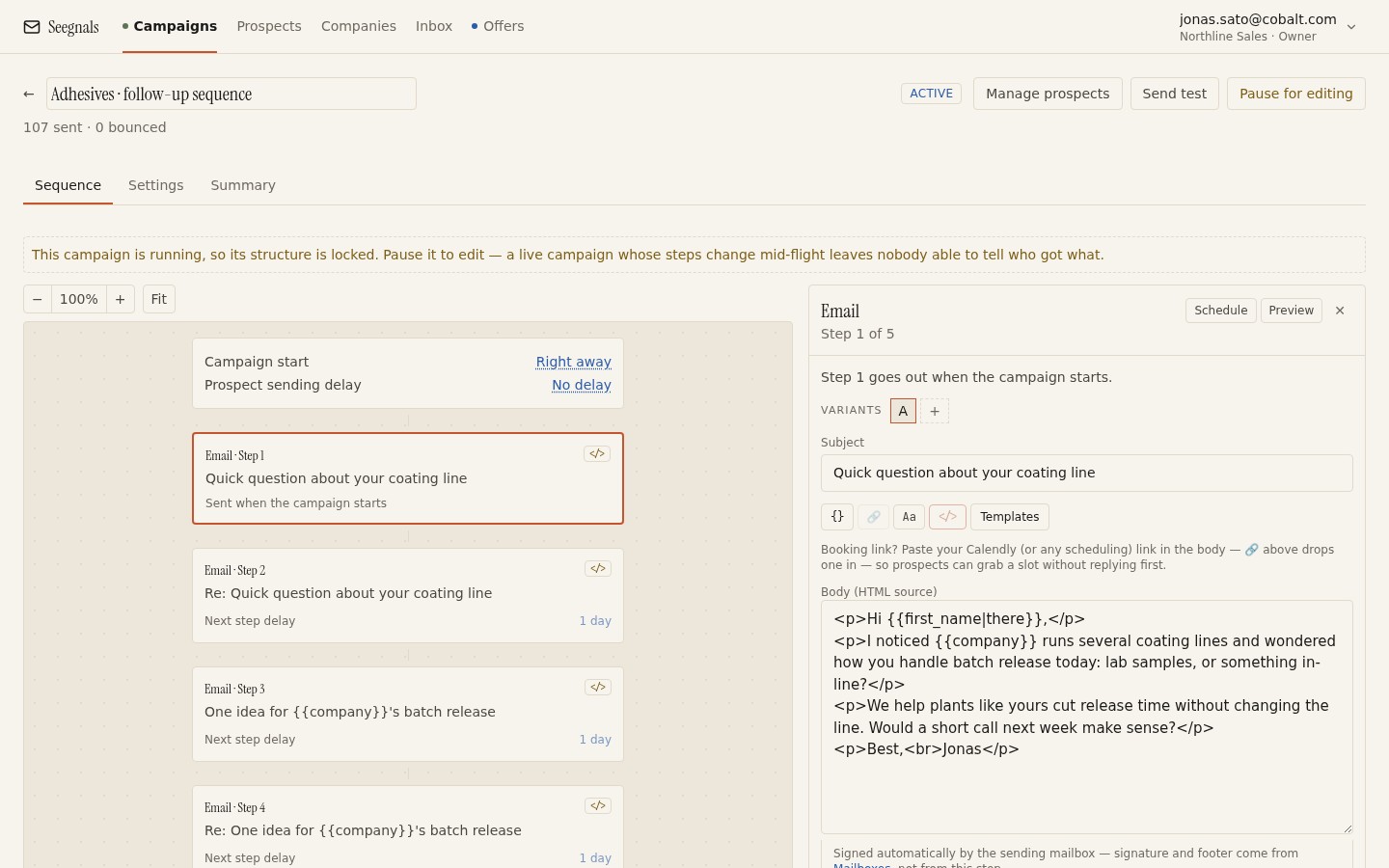 Delays sit between steps here; the sending window that governs when each one is allowed to fire is the other half of the same schedule, read in the prospect’s own time.
A window this size also does something the folklore ignores: it produces volume spread across the day rather than one burst at 10am from every sender who read the same article. A daily limit per mailbox, spread over a working-hours window with randomised gaps between messages, looks like a person working through their day rather than a script firing on the hour. That pattern matters more for reaching the inbox than any specific hour does, and it is covered in more depth in cold email daily sending limits per mailbox.
When the timezone is unknown
Not every prospect’s timezone is knowable with confidence. A country can be inferred from a domain or an address, but country is not always timezone, and a list import rarely carries a time zone column on its own. The honest move is a sensible fallback.
A reasonable default is your own workspace timezone: the one your team actually works in, which is also the timezone your replies get answered in. If you can infer a country reliably, that narrows things further, but a wide window absorbs the remaining uncertainty better than a narrow one aimed at a single inferred hour ever could. The wider the window, the less any one guess about timezone has to be exactly right.
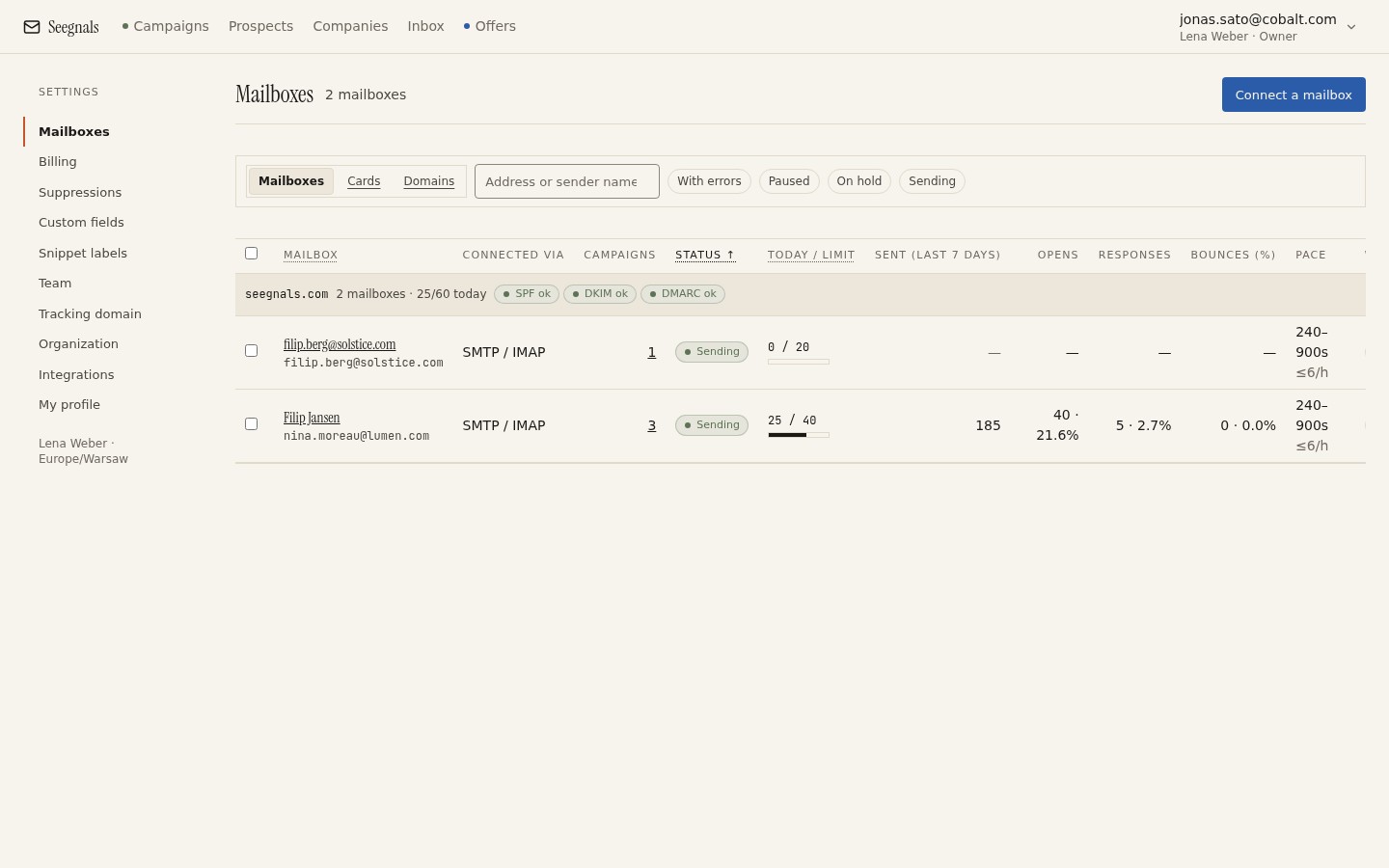 Volume spread across a window and across mailboxes, as explained in mailbox rotation, produces the same pattern a careful person sending by hand would leave behind.
Rotating a campaign across several mailboxes, each with its own daily limit, is the other half of this picture: it lets the window’s volume land through the day without any single address sending in a burst. How that rotation works is explained in mailbox rotation explained.
Apply the same timing rule to every follow-up
A four-step sequence does not need a different best-time theory for each step. The same window, applied consistently in the recipient’s timezone, should govern every step, because the point was never to find a magic hour for the opener; it was to keep every message inside the recipient’s working day. What changes between steps is the content and the gap. The hour-of-day logic stays put, and how to size that gap is covered in how many follow-ups belong in a cold email sequence.
Where “best time” thinking does real damage is when a team narrows the window to chase a supposed peak hour and then wonders why the sequence takes twice as long to finish, because a narrow window has fewer slots to place messages in per day. A wider window, held steady, moves a sequence along faster and is still fully within the recipient’s working day.
Find your own sending window through testing
If you want to know whether your list responds better on some days than others, the answer is in your own data, read carefully. Compare interested replies across a few campaigns with the same window, the same segment and the same message, the way you would run any other comparison; the same discipline used for subject lines and body copy in A/B testing cold email subject lines and variants applies here. A pattern that repeats across several campaigns to the same kind of account is worth keeping. A single campaign’s numbers are not, for the same reason a single coin flip is not a rule about the coin.
As explained in reply rate is the wrong north star, raw reply volume can mislead even on your own list. The same caution applies twice over to a claimed best hour built from someone else’s reply volume rather than yours.
What to do this week
- Check whether your sending schedule is applied in each prospect’s own timezone or in yours; if it is yours, that is the first thing to fix, ahead of any question about which hour to pick.
- Widen a narrow window (a single two-hour slot, say) to a full working day across two or three weekdays, and let the schedule spread messages within it.
- Confirm the fallback timezone used when a prospect’s is unknown, and set it to your workspace timezone if it is not already.
- Leave the window steady for the next few campaigns rather than adjusting it after each one; you need repeated data to see a real pattern.
- If you want to compare days or hours for your own list, treat it as a proper test: same segment, same message, only the window varies, read after several campaigns rather than one.