Somewhere in most cold email threads there is a moment when the next email is the wrong move. The prospect has replied twice, asked a question that takes three paragraphs to answer properly, and you can feel the exchange slowing down under its own weight. The right move is a call. The wrong move, which most people make, is to answer the question with the three paragraphs and paste a calendar link at the bottom.
Calls are not better than email. They are different. Email is good for precision, for records, for letting someone respond in their own time. A call is good for ambiguity, for questions that branch, for the moment when the prospect needs to decide whether they trust you. Moving too early wastes the prospect’s time and reads as pushy; moving too late leaves a deal stalled in a thread that has run out of room.
This article covers the signals that a call is welcome, the signals that it is not yet, how to propose one without the calendar-link ambush, and what to send before and after. It assumes you are working replies from a cold outbound campaign and that you can see the company context beside each thread, as described in why the company is the unit.
Email and calls do different jobs
Before the signals, the principle. Ask what the next exchange needs to accomplish and pick the medium that does that job.
Email wins when the content is a fact, a number, a document or a yes or no. It wins when the prospect has said they prefer it, when there is a time zone gap that would make a call awkward, and when you need a record (pricing confirmations, scope agreements). It also wins early, when the prospect does not yet know you and a call is a large ask.
A call wins when the question has branches (“it depends on how you handle X”), when the prospect’s real objection is not the one they wrote, when several people need to be aligned at once, and when the decision depends on trust rather than information. It also wins when the thread has grown to the point where either side is rereading to remember what was said.
The mistake is treating a call as a promotion the prospect earns by replying. A call is a tool, and you offer it when it is the right tool.
Signals that a call is welcome
You will not get a message saying “please call me”. You get these instead.
A question that branches. “How would this work if we have three sites with different systems?” Answering in email means three scenarios, each with caveats. Answering on a call means fifteen minutes and a shared understanding. When your draft reply passes two paragraphs and you are still adding “it depends”, stop and propose the call.
A second person joins the thread. Someone was copied in, or a colleague replied instead of your contact. Two people with different concerns are hard to serve in one email; they are easy to serve in one conversation. When a colleague replies instead of your prospect covers the reply itself; the call is often the natural next step.
A reply with a timeline in it. “We are reviewing options this quarter” or “we need something in place before the audit in November”. A prospect who volunteers a timeline is telling you the decision is real. A call is how you learn the shape of that decision.
They start asking how you work. “How long does onboarding take”, “who would we deal with”, “what happens if it does not work out”. These are trust questions. Trust is built faster on a call than in a thread.
The whole company is warming up. If the company card shows several people opening, a click on a pricing page and a reply from one of them, the account is moving. A call with the person who replied, framed around what the company is trying to do, fits the moment. What to do when an account heats up covers the account side.
A reply classified Interested that asks for nothing. “Sounds relevant, tell me more.” There is nothing to answer in email except more of what you already sent. Offer the call, and offer a written alternative in the same breath.
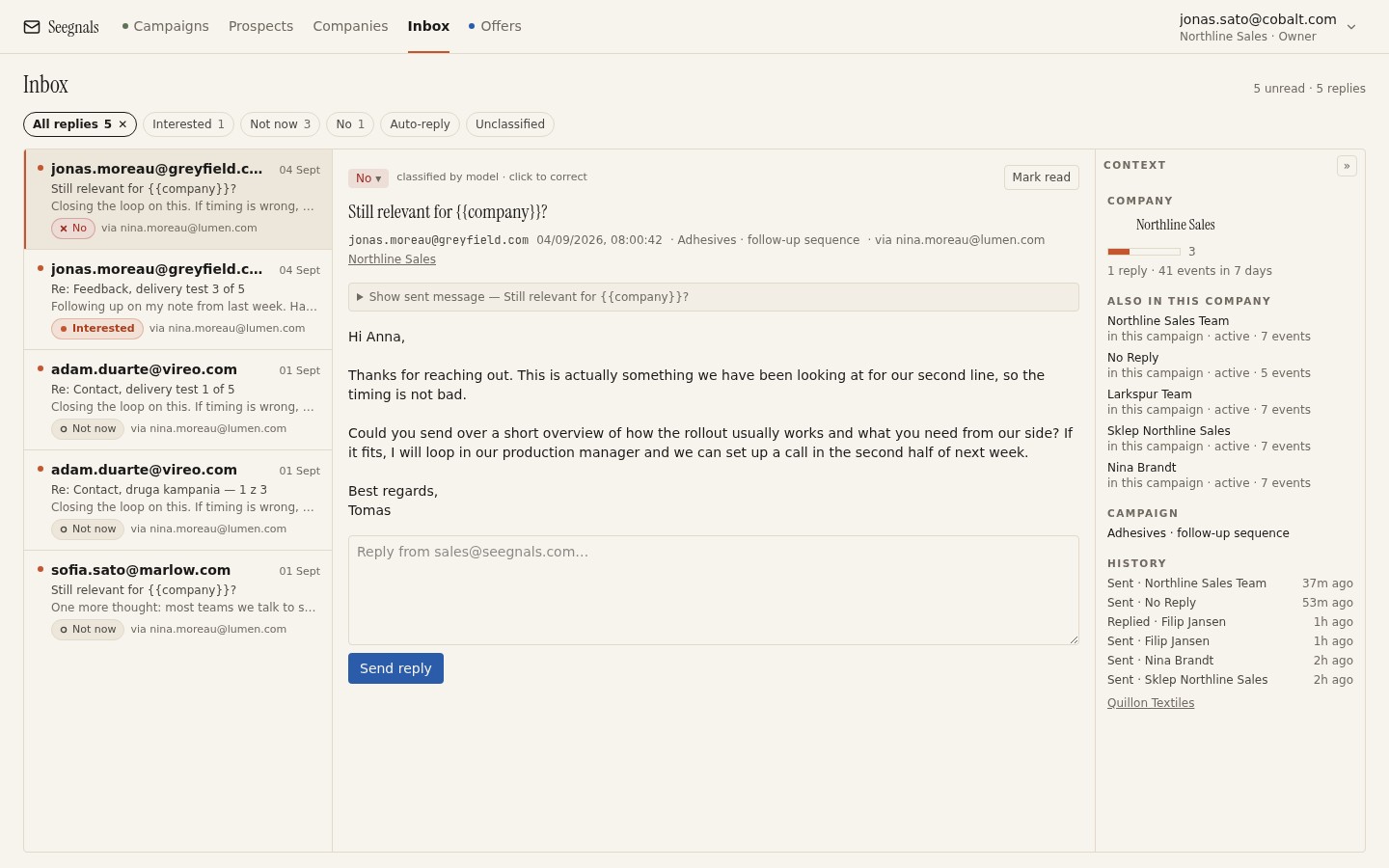 The classification tells you the reply is warm; the company context beside it tells you whether the account is moving too. Both together are the signal to offer a call rather than another paragraph.
Signals to keep waiting
Equally important, because proposing a call at the wrong moment costs you the thread.
The first reply. Unless it explicitly asks for a call, the first reply to a cold email is a test of whether you are worth a second one. Answer it well, in email, and briefly.
A factual question with a factual answer. “Do you integrate with Pipedrive?” Yes or no, one line, then a sentence about what that means for them. Turning this into a call proposal reads as evasion.
Maybe later. “Not the right time, try me in Q1.” A call proposal here ignores what they said. Say thank you, ask if there is anything worth sending in the meantime, and set the date. Sorting replies into Interested, Maybe later and Not now covers what each class means for the next move.
A reply that asks for a price. Give a price or a range in writing. A prospect who asked for a number and gets a calendar link instead assumes the number is bad.
An out-of-office or an autoreply. Not a signal of anything except absence.
The pattern: if the prospect asked for something you can give in one email, give it. The call is for what an email cannot do.
How to propose a call without the ambush
The calendar-link ambush is the message that answers nothing and ends with “grab a time that works for you: [link]”. It fails because it asks the prospect to do the work (find a slot, commit to a duration, appear at a time) before they have decided the call is worth it, and because it treats a busy person’s diary as your funnel.
Propose a call the way you would to a colleague.
Say why a call, in one sentence tied to their message. “Your question about the three sites has a few branches, and I think fifteen minutes would answer it faster than a long email.”
Name the duration and keep it short. Fifteen minutes is easy to say yes to. Thirty is a meeting.
Offer two specific times in their timezone. “Would Tuesday at 10 or Wednesday at 2, your time, work?” Two times is a question; a link is a task. If you must use a booking link, offer the two times first and put the link after as a fallback: “or pick anything here if neither suits”.
Offer the written alternative. “If email is easier, I can set the three scenarios out in writing instead; it will just be a longer message.” This is the sentence that stops the proposal reading as pressure. Prospects who take the written option were never going to take the call, and you have kept the thread.
Set expectations for the call. “No slides, no demo unless you want one.” Most prospects avoid calls because they expect a pitch.
Keep the whole thing to four or five sentences, in the same thread, from the same mailbox. A call proposal that arrives as a new email with a new subject reads as a campaign step.
Before and after the call
Before. Confirm with one line the day before, and send nothing else. If the company is in your workspace, open the company card before you dial: who else has been contacted, what they opened, whether a proposal is already out. The timeline there is the briefing.
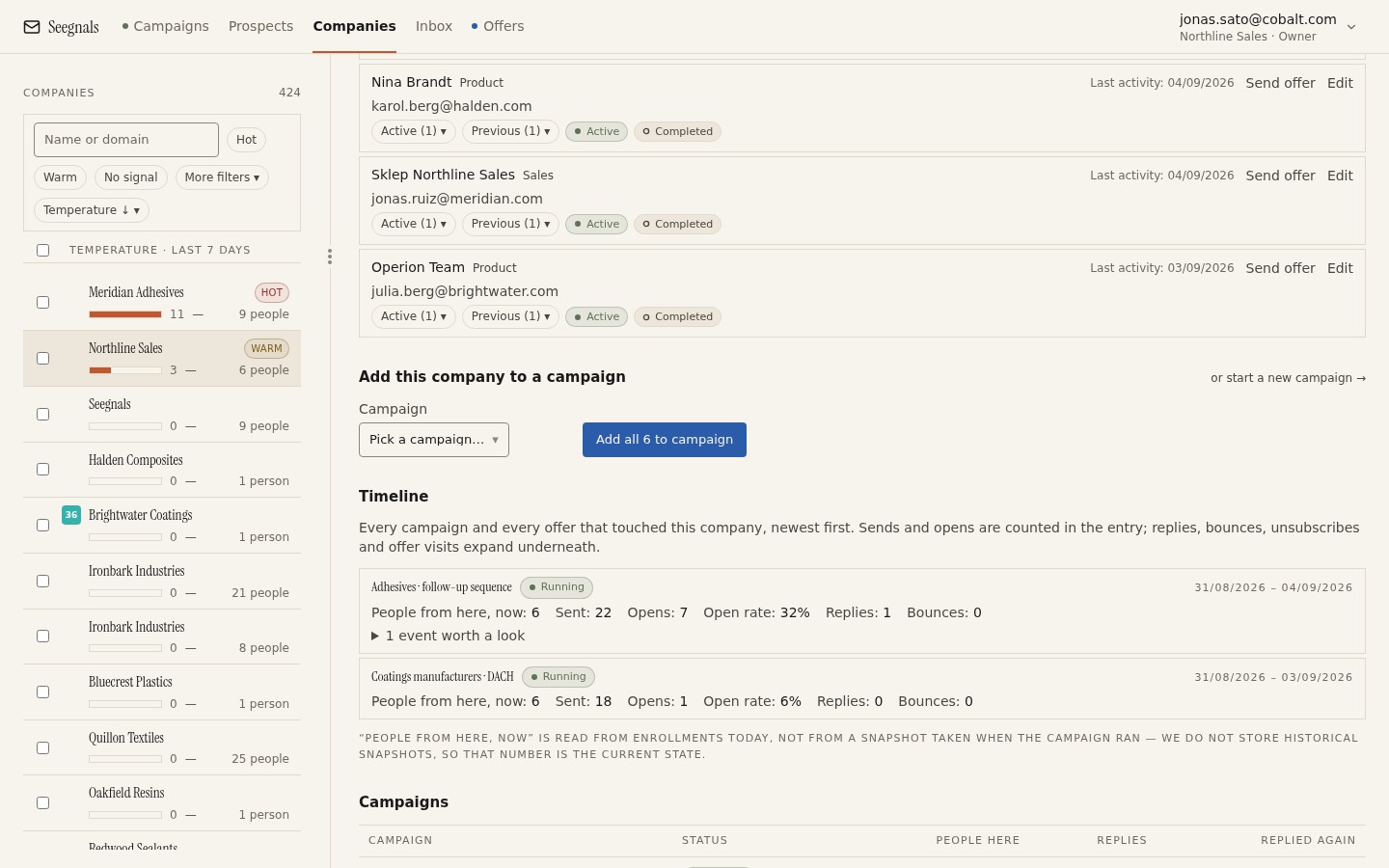 Your pre-call briefing. Everyone contacted at the company, every open and reply and proposal visit in one list, so nothing on the call comes as a surprise to you.
After. Go back to email within the hour, in the same thread, with the two or three things agreed and the next step with a date. This is where email’s precision does its job: the call built the understanding, the email records it. If a proposal is the next step, the covering email is its own craft; the cover letter email for a proposal covers it.
If the call did not happen (no-show, rescheduled twice), do not chase the call. Go back to the written alternative you offered, deliver it, and let the thread continue in email. You lose nothing, and the prospect who was avoiding the call often replies to the message.
When the call should go back to email
A call is not a permanent upgrade. Some things should move back to writing as soon as they come up.
Prices, scope and dates: confirm in writing the same day.
Anything the prospect needs to show a colleague: write it so it can be forwarded.
A prospect who is clearly more comfortable in writing: some people think better with a keyboard, and forcing calls on them costs you the relationship. If a prospect answers email in an hour and calls in a week, take the hint.
The proposal itself: always a document, sent as a personal link, so the reading tells you what the call did not. Where this sits in the wider process is covered in a sales process for a two-person team.
What to do this week
- Open your inbox and, for every thread with two or more replies, decide whether the next exchange needs a call or an email, using the branching test: if your draft reply has more than one “it depends”, propose the call.
- Rewrite your standard call proposal to the five-sentence form: why, duration, two times, written alternative, what it is not. Remove the bare calendar link.
- Before each call this week, open the company card and read the timeline; note one thing you would not have known otherwise.
- After each call, send the summary email within the hour, in the same thread.
- Find one prospect you have chased for a call twice; send the written alternative instead and stop proposing the call.