By the end of a cold email the reader has decided one thing: whether the problem you described is theirs. The call to action is where you find out. Most cold emails ruin this moment by asking for too much, asking for two things, or handing the reader a link and expecting them to do the work.
The ask that works is small, single and about interest. That rules out “book a demo”, “here is my calendar” and “would you be open to a call next week or the week after”. Just: is this a problem worth a conversation? A question a busy person can answer with one word on their phone.
This piece covers why one ask beats two, why interest beats time in the first email, what is wrong with a calendar link in step one, how to phrase the question, and, most usefully, what kinds of replies each ask produces and what to do with them.
One ask, because two is none
An email with two asks (“would you like a demo, or shall I send some material?”) feels generous. It reads as a menu, and menus require a decision about which item to choose before the decision about whether to reply at all. Two decisions is one too many for a stranger’s email read between meetings.
There is also a subtler cost. The second ask is usually an escape hatch, and the reader knows it. “Or I can send some material” tells them that you expect a no, and gives them a polite way to give one without saying so. You get a request for a PDF that is never read, and you count it as a reply.
One ask means one decision. The reader answers it or does not. Either way you learn something clean.
Focus the first ask on genuine interest
The first email should ask whether the problem is worth talking about. It should not ask for the talk itself.
The reason is sequencing. Agreeing to a meeting means committing time, checking a calendar, and admitting to a colleague that you booked a call with a cold emailer. Agreeing that a problem is worth a conversation costs nothing and admits nothing. The second is a step a stranger can take; the first is a step a mildly interested contact can take, which is a different person.
So the ask in step one is a yes or no question about interest. Some forms that work:
“Is this worth a short conversation, or is it not a problem for you at the moment?”
“Would it be useful to see how this works for a plant your size?”
“Is stock counting across the two sites something you are looking at this year?”
Each one can be answered with “yes”, “no”, “not now” or “wrong person”. Each of those is a useful reply. The email’s job is to produce one of them, and the meeting comes in your reply to the yes.
Save the calendar link for step two
Calendar links are convenient for the sender. They move the scheduling work to the reader, and in a warm relationship that is fine. In a cold email they signal three things the reader does not like.
That you assume the answer is yes. The link skips the question of whether they are interested and goes straight to when.
That you want their time before you have earned their attention. A calendar page with thirty-minute slots is a request for half an hour from someone who has given you ten seconds.
That the email is a template. Nobody sends a personal note to a peer and ends it with a booking page.
The practical result is that the link is not clicked, and because the email had no other ask, there is nothing to reply to. You have turned a possible one-word reply into a silent non-click.
Once someone has replied with interest, the situation reverses. They have opted in to the conversation; a calendar link in your reply saves them the back and forth, and it is welcome. The link is not the problem. Its position is.
Phrasing the question
A good ask has four properties.
It is a question. Statements (“I would love to show you…”) leave nothing to answer.
It is closed. “What do you think?” is open and requires a paragraph. “Is this relevant?” is closed and requires a word.
It gives the reader permission to say no. “Or is this not a priority right now?” halves the social cost of replying and, counterintuitively, produces more yeses, because people who were going to ignore the email now reply “not right now”, and some of those become “maybe in Q1”, which is a lead.
It is the last sentence. Nothing after the question. No signature paragraph about your company, no PS with a link, no “looking forward to hearing from you”. The question sits at the end where the reader’s thumb is.
Keep the ask identical across the segment. Personalisation belongs in the first line, as first lines that are not embarrassing explains, and the observation there should point straight at this question. If the first line is about a second warehouse, the ask is about counting stock across two sites; if the two do not connect, one of them is wrong.
What replies each ask produces
This is the part worth reading twice. Different asks produce different mixes of replies, and the mix tells you what to fix.
An interest question (“is this worth a conversation?”) produces a spread: some “yes, tell me more”, a good number of “not now”, some “wrong person, try my colleague”, and a few “no”. That spread is healthy. The “not now” group gets a date and a note; the “wrong person” group gives you the right person, which when a colleague replies instead of your prospect walks through; the “no” group tells you about the list.
A meeting ask (“do you have twenty minutes next week?”) produces fewer replies, and the ones you get skew to polite refusals: “we are all set”, “no budget”, “not at this time”. People say no to time more readily than they say no to a question, and the no is final in a way that “not now” is not.
A material ask (“can I send you our brochure?”) produces the most yeses and the least value. A yes to a PDF is a yes to ending the conversation without being rude. If you do want to send a document later, send it as a tracked offer after a real reply, so you can see whether it was read; what happens after you send the PDF covers that stage.
Two asks in one email produce the worst of both: fewer replies, and replies that answer the easier ask.
Sorting the replies is what makes this visible. In Seegnals every reply from every connected mailbox lands in one inbox and is classified automatically as Interested, Maybe later, Not interested, Autoreply / Out of office, Bounce, Unsubscribe request or Other; a classified reply stops the sequence for that person, and you reclassify with a click if the sorter got it wrong. Over a campaign, the Stats tab shows Responded and Interested as separate tiles, and the difference between them is the honest measure of your ask.
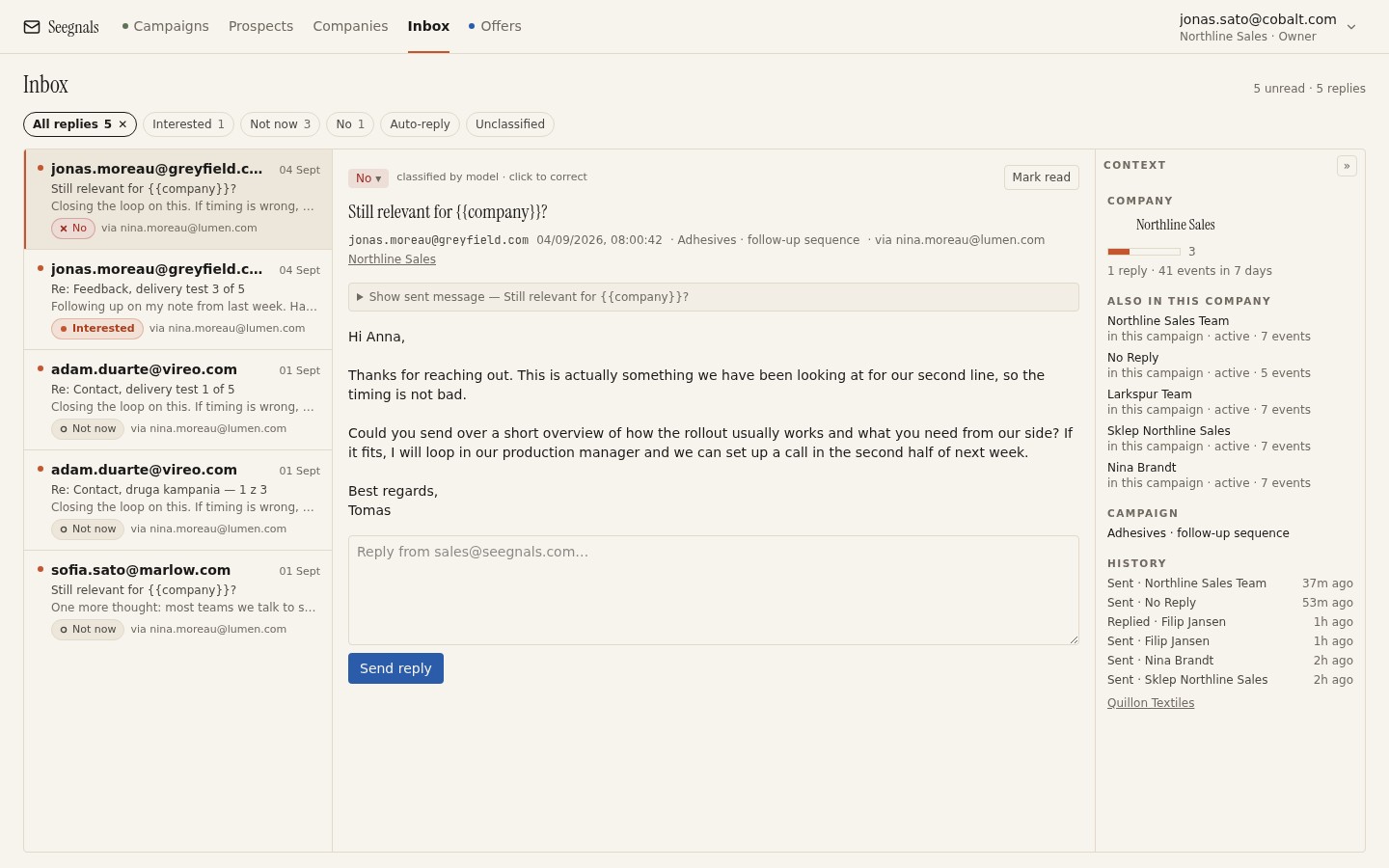 The mix of interested, maybe later and not interested replies is the ask talking back to you; read it before you touch the copy.
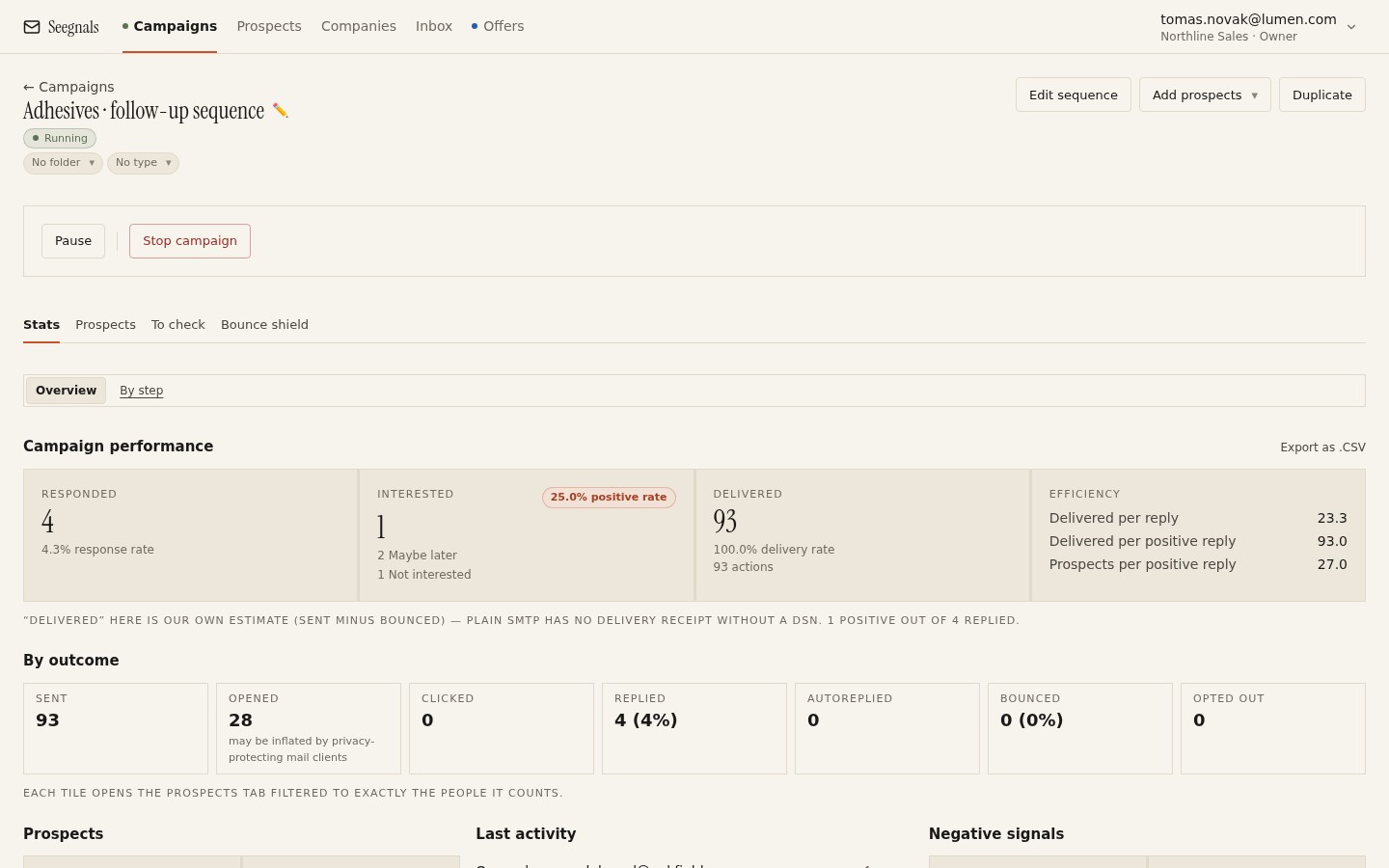 Responded minus Interested is the number of people who answered without wanting anything; a large gap usually points at the ask rather than the list.
Changing the ask before anything else
When a campaign gets opens but few replies, the instinct is to rewrite the whole email. Change the ask first. It is one sentence, it is the sentence the reply is a response to, and it is the cheapest thing to test.
Run two asks as A/B variants of the same step, with the rest of the email identical. Compare not the reply count but the interested count and the “maybe later” count; the method is in A/B testing subject lines and variants. If the interest question produces more useful replies than the meeting ask, you have learned something about your whole segment, well beyond this campaign.
Only once the ask is settled should you go back to the first line, and only after that to the subject. The order matters because each one frames the next: a good subject gets the first line read, a good first line gets the ask read, and the ask is what produces the reply. Everything upstream serves that last sentence.
The ask in follow-ups
Follow-ups can vary the ask slightly, as long as each email still has one. Step two might narrow it: “is this the right team, or should I be talking to operations?” Step three might make it easier still: “shall I close this off, or is it worth a look later in the year?” The last step in a sequence is a good place for the explicit permission to say no; a surprising number of “yes, actually” replies arrive at that point, and the “no” replies clean up your list. How many steps to run is covered in how many follow-ups in a cold email sequence.
What never changes: one question, closed, at the end, answerable with a word.
What to do this week
- Open your step one and count the asks. If there is more than one, delete all but the interest question. If there is a calendar link, remove it and save it for your reply to the first yes.
- Rewrite the ask as a closed question that gives permission to say no, and make it the last sentence of the email.
- Write a second ask and run the two as A/B variants of step one, changing nothing else.
- After the batch has had its follow-ups, compare Interested and Maybe later between the variants.
- Read every “not now” reply and give each one a date; those are the pipeline the meeting ask would have thrown away.