The first line of a cold email is the only line you can be sure is read. It shows in the preview pane next to the subject. It decides whether the email is opened, and if it is opened, whether the second line gets a chance. Most first lines fail that test before the reader has finished them.
They fail in predictable ways: “I hope this email finds you well”, a compliment about the reader’s website, an introduction of the sender and their company, or a fake question (“Are you struggling with…?”). Each one tells the reader that this is a template, and the reader stops.
A first line that works does two things in one breath. It makes a specific observation about the reader’s company, something they would recognise as true and that a machine could not have guessed. Then it gives the reason you are writing now: what connects that observation to your email today. This piece covers why compliments fail, how to find an observation, how to state the reason, and how to test what you write.
Why the compliment has to go
Compliments feel polite, which is why people use them. To the reader they do the opposite of what you intend.
A compliment about the company’s growth, website or “impressive work” cannot be checked, so it carries no information. It is the kind of sentence that fits any company, and the reader knows it. It also puts them in the position of being flattered by a stranger who wants something, which is uncomfortable. And when the compliment is wrong (the growth was a downsizing, the post they “loved” was written by someone else), the email is over.
The same applies to “I hope this finds you well” and to opening with who you are. The reader does not yet care how you are or who you are. They will, if the first line earns it.
The honest replacement for a compliment is an observation. It does the job the compliment was trying to do, showing that you looked, without asking the reader to feel anything.
What counts as an observation
An observation is a fact about the reader’s company or role that you could point to if asked. Three tests.
It is specific. “You run three sites in Bavaria” passes. “You are a leading manufacturer” fails.
It is checkable. If the reader replied “where did you get that”, you could answer with a page, a listing, a filing or a photo.
It is about the business. Their product range, their locations, their suppliers, a job they are advertising, a certification they hold, a market they entered, a regulation that applies to them. Not their personal profile, their weekend, or their family. Personal observations in B2B cold email read as surveillance and undercut the legal footing of legitimate interest; the boundaries are in GDPR and cold email.
Most observations do not need to be unique per company. As personalisation that scales without lying argues, a fact that is true of the whole segment, written well, reads as personal to each reader. “Food producers with more than one plant usually run different changeover procedures at each site” is an observation about a segment, and every plant manager on the list will read it as being about their plants. Where one detail really does differ per company, a custom field carries it, with a fallback for the rows where you could not find it.
The reason you are writing now
An observation on its own is a fact without a purpose. The reader thinks: so what? The second half of the first line, or the second sentence, answers that. It says why this fact means you are writing today rather than any other day.
The reason can be a change at their company (a new site, a new product line, a job advert for a role your product replaces or supports), a change in their world (a regulation, a supplier exit, a price shift), or a connection to something you have done for companies like theirs, stated as a fact rather than a boast.
Put together, a first line reads like this: an observation, then a because.
“You are advertising for a second maintenance planner at the Regensburg plant, which usually means the current one is spending their week chasing spare parts.”
“Your product page lists four grades of film for frozen goods, and since the January change in the packaging regulation those all need a recyclability declaration.”
“You opened a warehouse in Łódź this spring; most companies that add a second site find their two teams are counting stock differently within six months.”
None of these flatter. None of them introduce the sender. Each one gives the reader something to check and a reason to keep reading. The sentence after them is the offer, in one line, and then the ask.
Length, and the preview pane
The first line is read twice: once in the preview text beside the subject, and once in the open email. In the preview it is cut off after a few dozen characters. So the observation has to land before the cut.
Aim for one line, under about twenty words, with the specific fact in the first half. “You are advertising for a second maintenance planner at Regensburg” is what survives the preview; “which usually means…” can come after the fold. If you cannot get the fact into the first half of the sentence, split it into two sentences and let the first one be short.
The subject line and the first line work as a pair. A subject that names the topic and a first line that names the fact is a strong combination; a subject that is a question and a first line that repeats it wastes the preview. How to write the subject is its own subject: subject lines that get opened.
Write the first line last
Most people write the first line first, because it comes first. That is why so many first lines are about the reader’s ego rather than about the reason for the email: the writer did not yet know what the reason was.
Write the ask first. Then the one-line offer that justifies the ask. Then go back and write the first line so that it points at the offer. The observation you choose should be the one that makes the offer obviously relevant. Interesting is not the same as relevant. If you sell inventory software, the second-site observation is the right one even if the company also just won an award.
Then read the three sentences together as the reader would. Observation, reason, offer, ask. If any one of them could be deleted without the email losing sense, delete it.
Testing openers honestly
Test the two first lines you cannot choose between. Run them as A/B variants of the same step, keep the subject and the rest of the body identical, and compare replies after the whole batch has had its follow-ups. A step-level variant comparison, of the kind in the campaign Stats tab, shows which opener produced replies rather than opens; opens are inflated by Apple Mail Privacy Protection and are a poor judge of copy.
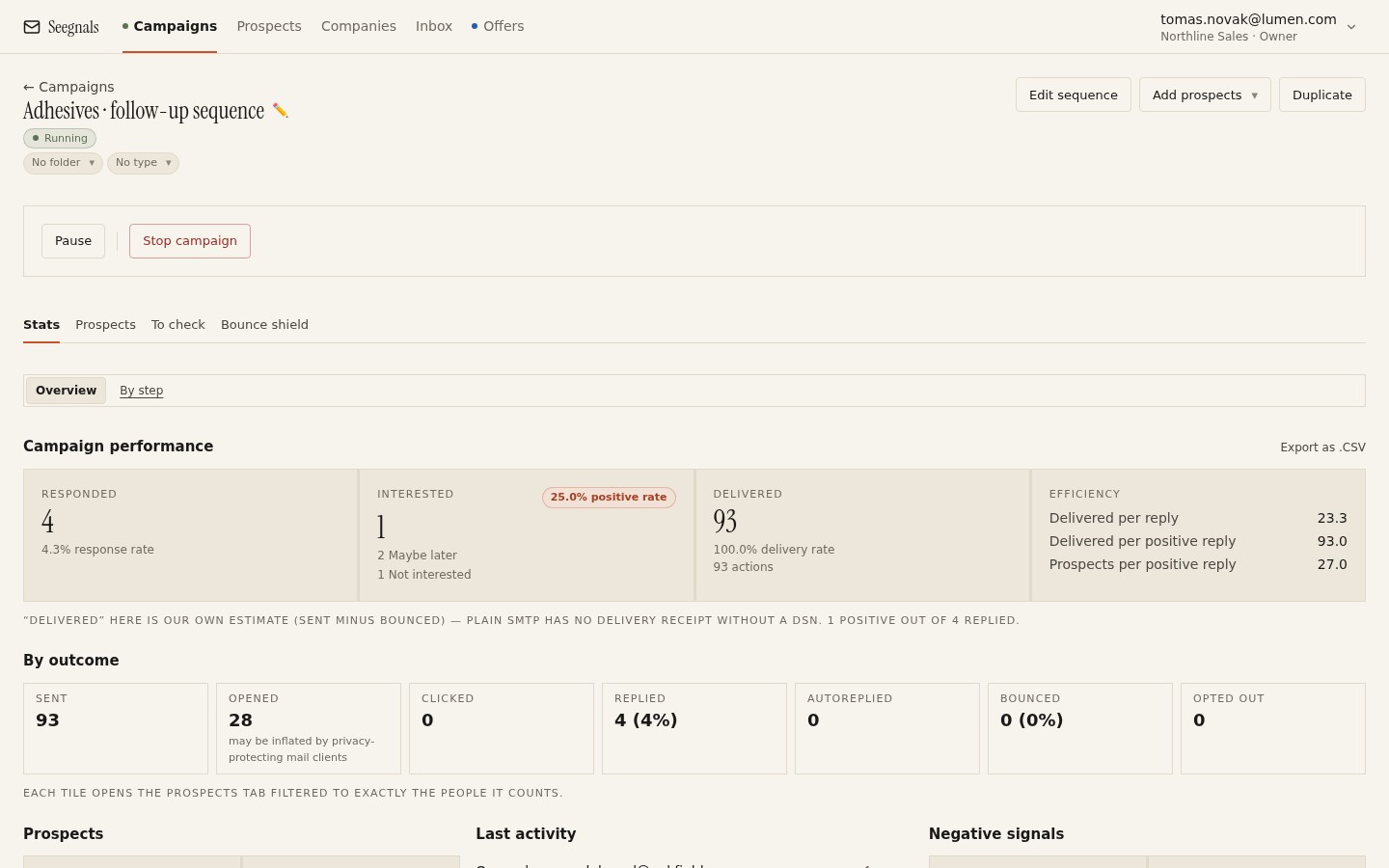 Judge an opener by replies and by interested replies. Clicking a tile shows you exactly which people answered which variant.
Two cautions. Change one thing at a time, or you will not know what won. And judge by replies from companies you wanted. A first line that provokes polite refusals is not a winner. The method and the pitfalls are in A/B testing subject lines and variants, and the reasoning about what to count is in reply rate is the wrong north star.
First lines for follow-ups
A follow-up has a different first line problem. The reader has already seen the observation; repeating it is dull, and “just following up” is worse. The follow-up first line should add a new fact or a new angle on the same problem: a second observation, a short example of what happened at a similar company (as a scenario, with no client named), or a direct question about whether the problem exists at all.
Because follow-ups stay in the same thread and come from the same mailbox, the reader sees them as one conversation. The first line of step three should read as the third thing you have said to this person. How many steps that conversation should have is covered in how many follow-ups in a cold email sequence.
What to do this week
- Open your current template and delete every compliment, every “hope this finds you well” and every sentence about yourself in the first three lines.
- For your segment, list five facts that are true of every company on the list and that a reader would recognise. Pick the one that most directly points at your offer.
- Write the first line as observation plus reason, under twenty words, with the fact in the first half. Read it in a mail client’s preview pane before you accept it.
- Write a second version with a different observation and run the two as A/B variants of step one, changing nothing else.
- Rewrite the first line of each follow-up so that it adds something new rather than repeating or bumping.