A proposal went out ten days ago. The prospect was warm on the call, said they would come back to you by the end of the week, and then nothing. You have sent one “just checking in” already. The next one is harder to write, because you can feel it turning into a nag, and the prospect can feel it too.
Nagging is not a matter of frequency. It is a matter of content. A follow-up nags when it asks the prospect for information you could have had, or gives them nothing in return for reading it. “Did you get a chance to look at the proposal?” nags because it asks them to report on their own inbox. “Any thoughts?” nags because it puts the work on them.
The alternative is three messages, each triggered by what the reader did rather than by your calendar, each carrying something the prospect did not already have, and a clear point at which you stop. This article gives you the three messages and the stopping rule. For the full map of triggers, see when to follow up on a proposal based on how it was read; here the focus is on what to write and when to give up.
Let reads trigger your follow-up
If the proposal went out as a personal link rather than an attachment, you know things the calendar cannot tell you: whether it was opened, how long the visit lasted, which pages held attention, and whether anyone came back. Seegnals records each visit and shows reading time per page and the list of returns. What happens after you send the PDF covers the mechanics.
Those events replace the calendar as your trigger. A follow-up sent because it has been three days is a guess. A follow-up sent because the proposal was opened yesterday, read to the pricing page, and not touched since is a response to something that happened. It arrives when the prospect is already thinking about you, and it can be specific because you know which part of the document was in play.
The rule that stops the nagging: one message per event, never two messages for the same event. If the proposal was opened and you have sent your post-open message, the next message waits for the next event, or for a long enough silence that silence itself becomes the event.
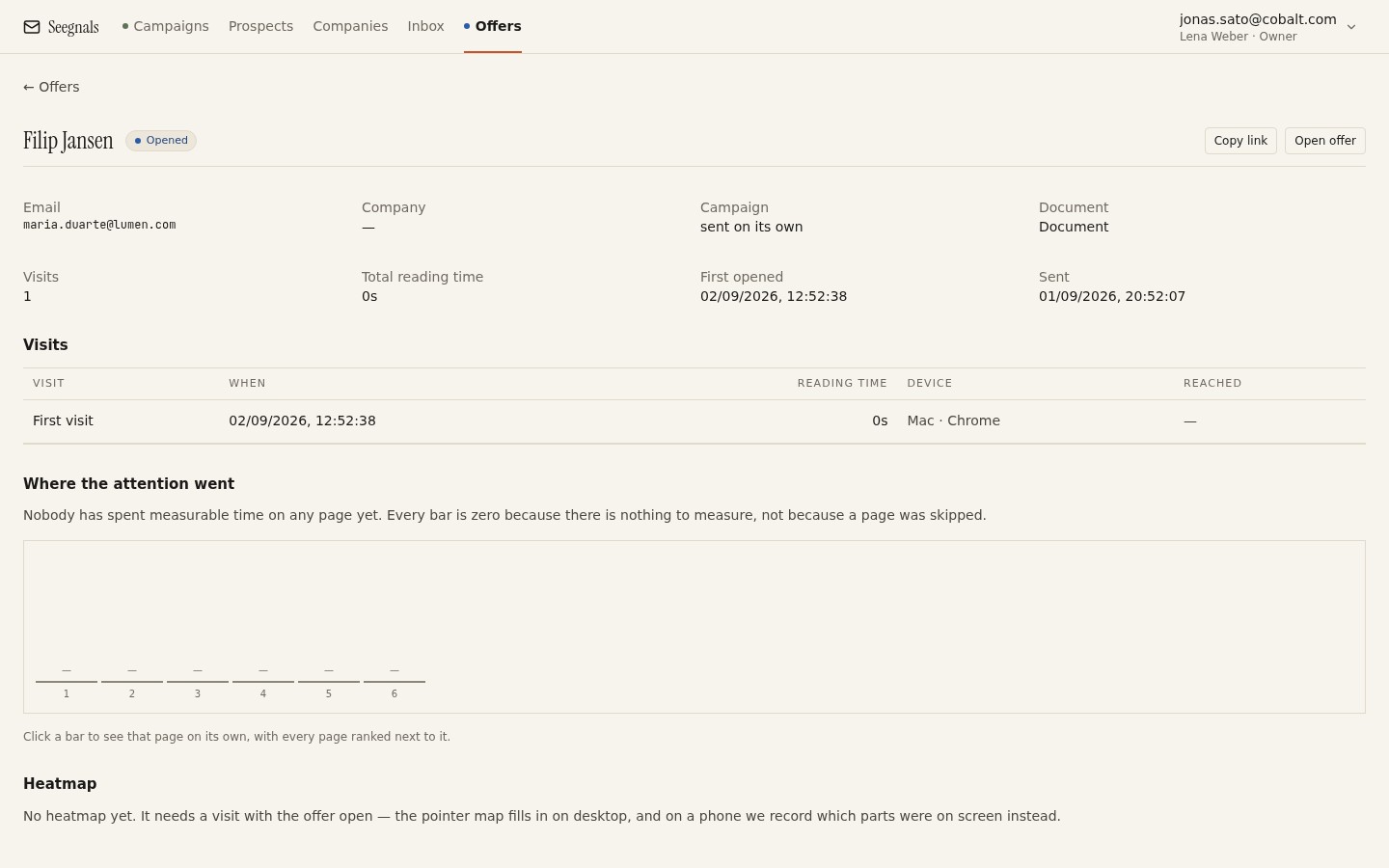 The bars tell you what to write about. A stall before pricing calls for the number in one sentence; a long stay on the implementation page calls for a clarification you did not think to include.
What counts as a long enough silence depends on how hard the proposal was read. A document opened once for two minutes on a phone deserves a nudge sooner than one read across three visits with a return to the terms page, because the second reader is clearly working on it and needs room.
Message one: the useful addition
Trigger: the first open has happened and the visit has ended. Or, if the proposal was never opened after two working days, the email itself is the problem and message one goes out anyway, with a different subject line.
Message one adds something. Not a question, an addition: a clarification about a page they spent time on, a one-line answer to the question you sensed on the call, a sketch of what the first month would look like for their team. It assumes they have read the document and it moves the conversation one step forward without asking them to do anything.
“One thing I should have made clearer on the pricing page: the onboarding fee is a one-off, and the monthly number is the one to budget for. If it helps, I can put a one-page cost summary together for whoever else needs to see it.”
Three or four sentences. Never a mention of the reading data itself. The observation (“they spent a long time on pricing”) becomes an offer (“I can put a one-page summary together”), and the offer is the whole message.
Message two: the honest question
Trigger: message one got no reply, and either a new event happened (a return visit, a new reader) or enough working days have passed that the silence is now the event. For a proposal that was read carefully, that is more than a week; for one skimmed once, less.
Message two asks a question, but an honest one, meaning a question whose answer costs the prospect a sentence and helps you both. Not “any thoughts?” and not “did you have a chance to review?”. Ask about the decision.
“Is the proposal still under discussion on your side, or has the timing shifted? If something in it does not fit how you buy, tell me and I will change it rather than have it sit.”
This works because it names the two most likely reasons for silence (internal discussion, changed timing) and gives permission for the third (the proposal is wrong). A prospect who has gone quiet out of politeness will often answer a question that lets them be honest without being rude.
If a return visit triggered message two, aim the question at what they returned to. A return to terms: “If procurement has questions on the terms, I am happy to talk to them directly.” A return to pricing before a round hour on a weekday: “If there is an internal meeting coming up, tell me what would make it easier and I will send it before.”
Message three: the exit
Trigger: no reply to messages one and two, no new events for a meaningful stretch. This is the last message, and it says so.
Message three gives the prospect a way out that costs them nothing, and it gives you a clean close instead of an open loop.
“I will assume this has gone quiet on your side and stop chasing. If it is just timing, tell me when to come back and I will put it in the diary. If you have gone another way, that is useful for me to know too, and no explanation is needed.”
Three exits offered: stop, later, or lost. All three are easy to type. People answer this message more readily than any other in the sequence, because it asks them to close a loop they feel bad about and it lets them do it in one line.
What message three must not do: repeat the pitch, add a discount out of nowhere, or pretend to be a new topic (“I came across this article and thought of you”). Each of those signals that you have not really stopped, and each makes the next proposal you send this company harder.
When to stop, and what stopping looks like
Stop after message three. If it goes unanswered, the deal is closed as silent, the company card gets a note, and the account moves to a longer cycle: a check-in in a quarter, tied to something real (their renewal date, a change on their side, a version of your offer that addresses what stalled).
Stopping is not the same as forgetting. The company card in Seegnals keeps the proposal events on the same timeline as every email to every person at that company, so a return visit a month later shows up next to whatever else has happened. A return after weeks of silence is the one event that justifies a same-hour message even after you have formally stopped: “I noticed the timing might have moved; is there anything I should update?” You are not reopening the chase; you are responding to a change on their side.
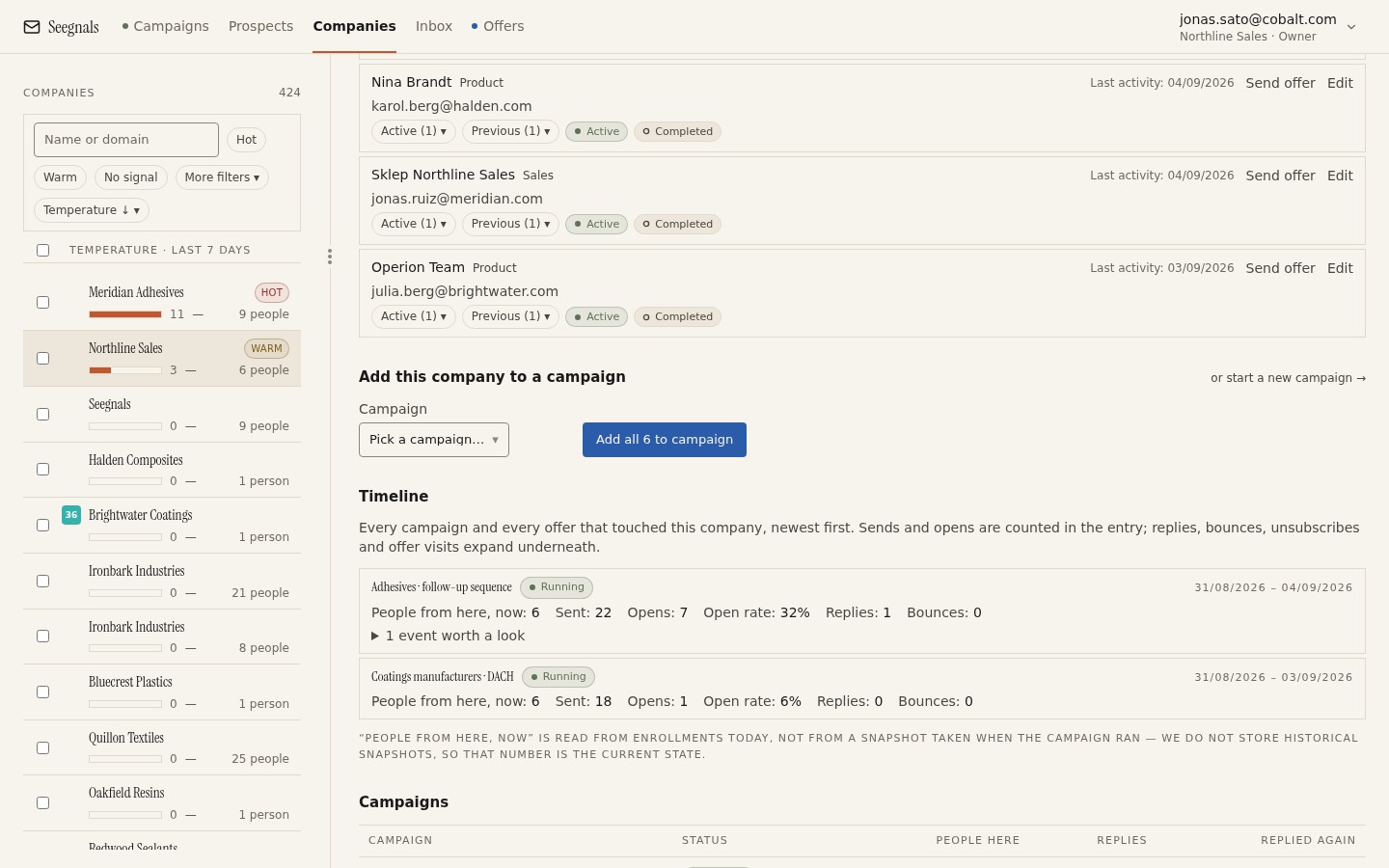 After message three, the card is where the account waits. A return visit weeks later lands on this timeline, next to any new person who replies, and that is your signal to write again.
There is one more stopping rule that is easy to forget. If someone other than your contact opens the proposal, or a colleague replies instead of the person you wrote to, the sequence resets, because you have a new reader. When a colleague replies instead of your prospect covers that case for email; the same logic applies to a forwarded link, and who else opened your proposal shows how to spot one.
Keeping the tone honest across all three
A few habits that keep three follow-ups from reading as a campaign.
Write each message when its trigger fires. The prospect can tell the difference between a note written today and a step three that was always going to arrive.
Send from the same mailbox as the proposal, in the same thread. Three subjects for one proposal is three interruptions. One thread is one conversation.
Never quote a number from the analytics, including the minutes, the page and the device. The data is for you.
Keep every message shorter than the last. Message one is four sentences; message three is three.
Say the thing you are afraid to say. “I will stop chasing” is the sentence most salespeople avoid, and it is the one that gets replies.
What to do this week
- List your open proposals and, for each one, write down the last event (first open, return, silence) and which of the three messages it has already received.
- For every proposal stuck after a “just checking in”, write message two as an honest question about the decision.
- For every proposal past message two with no events for over a fortnight, send message three and close it as silent if nothing comes back.
- Add a check-in date a quarter out to the company card note for every silent close, tied to something real on their side.
- Reread your follow-up template and delete every sentence that quotes analytics or asks the prospect to report on their inbox.