Tracked proposal links tell you things the reader does not know you know. When they opened it. How long they stayed. Which pages held them and which they skipped. Whether they came back the night before the meeting. Whether someone else opened it from another device.
All of that is useful and all of it can be misused. The misuse is rarely malicious; it is usually a salesperson who is pleased to have information and shows it. “I noticed you spent a while on the pricing page” feels, to the sender, like attentiveness. To the reader it feels like being watched through the window. The deal does not recover from that easily.
This article is about the line. Where to be open about the tracking, how to use what you learn without revealing it, and the specific things you should never say. It is written for people who send a handful of offers a week, want the information, and want to stay the kind of supplier a buyer trusts. If you are new to the mechanics, what happens after you send the PDF covers them.
Why this needs a rule
Two people, the same information, opposite outcomes.
The first follows up an hour after the first open with “Saw you opened it, any thoughts?” The reader, who was skimming between meetings, now knows two things: that they are being watched, and that the supplier is waiting. Both make the next conversation worse.
The second waits until the reading session is over, notices that the time went to the pricing page, and sends, that afternoon: “If it helps, I can put together a one-page cost breakdown for anyone who needs to sign this off.” The reader, who was indeed looking at pricing, sees a supplier who anticipated the question. Nothing about the tracking is visible.
Same data. The difference is not that one used it and the other did not; both did. The difference is that the second person turned an observation into an offer and left the observation out.
That is the rule in one line: use what you know to decide what to offer; never show what you know.
Say once that the link is tracked
Being open about tracking is not in tension with the rule. It is the other half of it. The reader should know, in general terms, that the link is a viewer and that you can see when it is used. They should not be reminded of it, and they should never be shown the detail.
The place to say it is the covering email, in one plain sentence. Something like: “The proposal opens in the browser at the link below; you can also download it. The link lets me see when it has been opened so I know when to follow up.” That is honest, it sets the expectation, and it takes the surprise out of a later follow-up that happens to be well timed.
Then stop. Do not put it in the follow-up. Do not put it in the signature. Do not mention it on the call. One sentence, once.
If your offer page carries your own domain and logo rather than a tool’s, the viewer reads as your document and not as a third-party tracker, which helps the reader take the sentence at face value. White-label proposal links covers how that works.
Turn observations into offers
Every signal from the tracking maps to something you can offer. The discipline is to send the offer and keep the signal to yourself.
A long stay on pricing becomes an offer of a cost breakdown, or to walk their finance colleague through the number.
A stop before pricing becomes a shorter version of the proposal, or a call to check you have understood the problem. Not “I saw you did not get to the price”.
A stall on the terms becomes “if anything in the terms is a problem, I would rather hear it now than at signature; happy to go through them.”
A return visit the evening before a round-hour meeting becomes, the next morning, “If it is useful for your internal discussion, I can join for ten minutes or send a summary slide.” Not “I noticed you were reading it last night.”
A second device or a visit from a colleague becomes material for a second reader: a one-page summary, a technical appendix, whatever the second person is likely to want.
Silence, the one signal that is not a signal, becomes a single message that gives them an easy way to say “not now” or “come back in March”. Not a fourth “did you get a chance to look”.
Notice that in every case the message would make sense to a reader who did not know the link was tracked. That is the test. If the message only makes sense because you can see the data, it reveals the data. Rewrite it. When to follow up based on reads works through the timing of each of these.
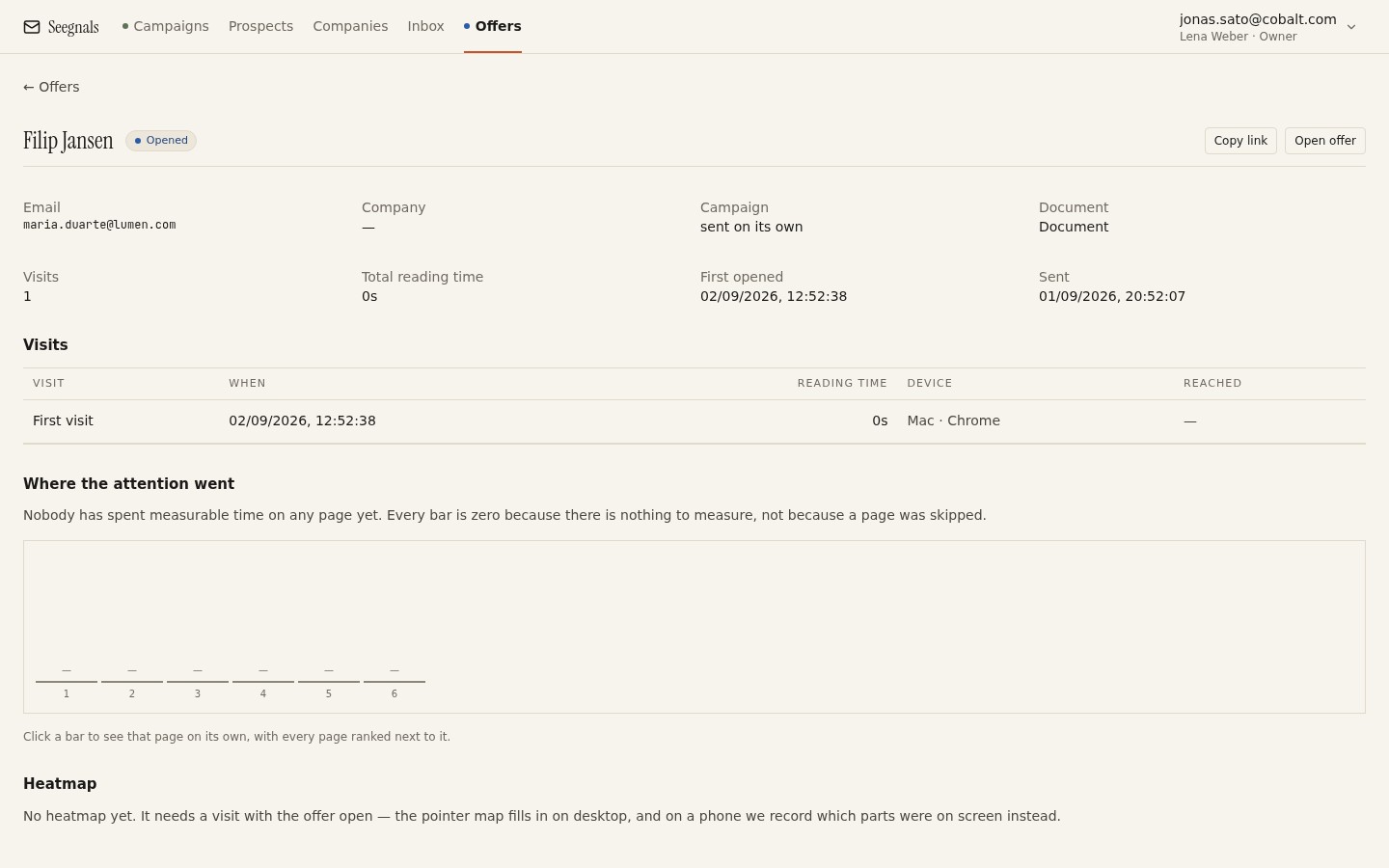 Everything on this page is for you: the visits, the per-page time, the device, the return count. None of it belongs in the message you send.
The line you should not cross
Some things are not judgement calls. They are on the wrong side of the line every time.
Never quote a time. “You opened it at 22:40” tells the reader you have a log of their evening.
Never quote a page. “You spent most of your time on page 7” tells them you have a record of their reading. Even framed helpfully, it is unwelcome.
Never quote a device or a location. “I see you looked at it on your phone” or anything that implies you know where they were.
Never quote a visit count or a return. “This is the third time you have opened it” is the sentence most likely to end the relationship.
Never name a forward. “I see your colleague has had a look” makes two people uncomfortable, one of whom you have never met.
Never use the tracking as a bargaining chip in a negotiation. “You clearly found it interesting given how long you spent” is a sentence you cannot take back.
Never contact a person who appeared in the tracking and did not contact you. If a second reader wants to talk, they will, or your contact will introduce them.
Never follow up during the reading session. The visit has a duration; wait for it to end. A message that arrives while the document is open is a message that arrived because the document was open, and the reader will work that out.
Never use the data outside the deal, including in a reference, a case study, a conversation with another prospect or an anecdote. It was collected to help you time one follow-up, and that is where it stays.
The list is long because each item is a temptation that arrives with the data. The data is good. The temptations are not.
Colleagues, forwards and the gate
Two situations need a little more than the list.
The first is the forward. Your contact sends the link to a colleague, and a visit appears from another device, sometimes another city. This is good news: the account is widening, and it will be visible on the company card as engagement from more than one person. The etiquette is simple. Say nothing about it. Send your contact material that a second reader would want, framed as something you would have sent anyway. Let the colleague come to you if they want to. Who else opened your proposal goes into how to read forwards and returns.
The second is the gate. Some offers should not be readable by whoever receives a forwarded link. For those you can require the reader to enter their email and a one-time code before the document opens, and to request access if their address is not on the list. This is a stronger form of tracking, because it identifies each reader, and it needs to be handled with the same openness as the link itself: say in the covering email that the offer is protected and why (“the pricing is specific to you, so the link asks for your email before it opens”). Explained, a gate reads as care. Unexplained, it reads as a trap, and a reader who hits an unexpected login screen often does not come back. Protecting a proposal link with a one-time code covers the mechanics; the offer gate entry has the short definition.
In Seegnals the gate is optional per offer, unknown emails can request access for you to approve, and the reader list sits on the offer page. As with everything else on that page, it is for your decisions.
What to do this week
- Reread your last five proposal follow-ups. Mark any sentence that only makes sense because you could see the tracking. Rewrite each one as an offer.
- Add one plain sentence to your covering email template saying the link opens in the browser and lets you see when it has been opened. Remove any mention of tracking from your follow-up templates.
- Write the six offers that map to the six signals (pricing stall, early stop, terms stall, return before a meeting, second reader, silence) as short templates you can send without thinking.
- If you use the gate, add a line to the covering email that explains it. If you do not explain it, do not use it.
- Agree the line with your team: no times, no pages, no devices, no counts, no forwards, no contacting second readers. Put it in writing where new colleagues will see it.