You sent the proposal to one person. The detail page shows five visits: two from a laptop on Tuesday, one from a phone that evening, and two on Thursday from a different laptop, in a different city, with a different reading pattern. Nobody has replied. Somewhere inside that company your proposal is moving, and you want to know where.
This article is about reading forwards and returns: what the events mean, how to tell a return from a forward, how to place both on the company timeline so they make sense, when to gate the link so you know exactly who is reading, and how to stay proportionate about all of it.
The mechanics of tracked links are covered in what happens after you send the PDF, and the per-page detail in reading time per page. Here we focus on the who.
The events you are looking at
A tracked proposal link records each visit with when it began, how long it lasted, what device opened it, and how far through the document the reader got. It counts returns, meaning the same link opened again after an earlier visit. Per-page reading time accumulates across visits.
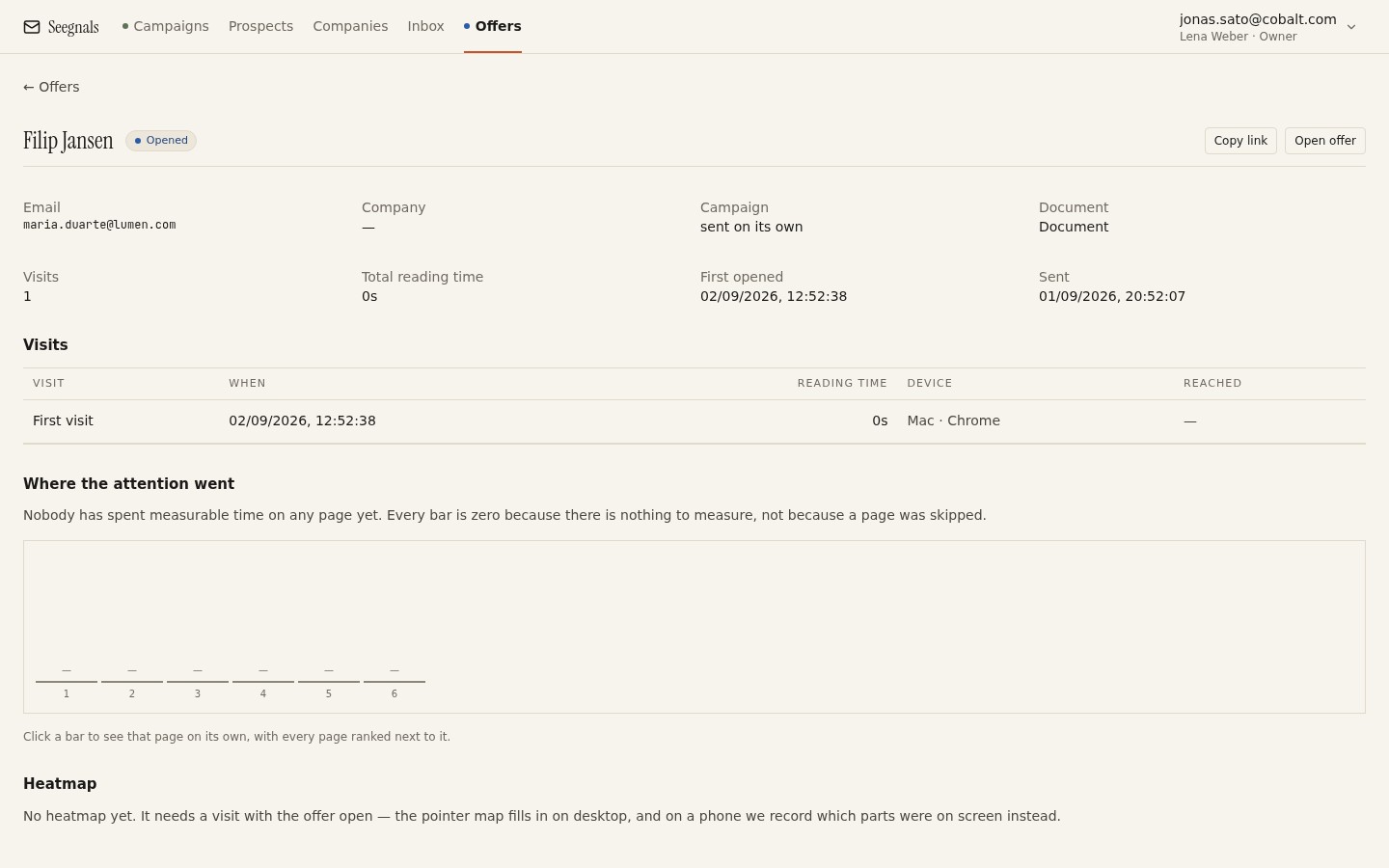 The visit list is the raw material: each line is one opening of the link, with its time, duration and device, and the pattern across lines is where forwards and returns show themselves.
What the link does not record, unless you gate it, is identity. The link is personal to the recipient, so every visit is attributed to them. When the recipient forwards the link, the colleague’s visit appears under the recipient’s name. The evidence that it was a colleague is circumstantial: different device, different location, different reading pattern.
That is the honest starting point. Everything in the next two sections is inference from circumstantial evidence, and you should hold it as such.
Returns: the same reader coming back
A return is the recipient opening the proposal again. It is one of the strongest signals a document can produce, because a person who has already read something and comes back to it is using it.
Returns have recognisable shapes.
The next-morning return. A first read late in the day, then a return early the next morning, often to the same one or two pages. The reader slept on it and is checking a detail. Usually pricing or timeline.
The pre-meeting return. A visit that starts shortly before a round hour and skims pricing and terms. Someone is about to present this to colleagues. If you have a relationship, this is the moment to offer to be on the call.
The comparison return. Several short returns across a week, each to the same page. They are comparing you with another proposal, line by line. Your page is the benchmark or the challenger; either way, the follow-up should make the comparison easy rather than avoid it.
The dormant return. A proposal that went quiet for weeks and is suddenly opened again. Something changed: budget, a project date, a competitor falling through. This is worth a same-day note asking whether the timing has moved.
Returns from the same device, in the same city, with consistent reading behaviour, are almost certainly the same person. When to act on them is the subject of when to follow up based on reads.
Forwards: a reader you did not send to
A forward looks like a return with the wrong fingerprint. Same link, but a device you have not seen, sometimes a location you have not seen, and often a reading pattern that differs from the first reader’s.
The reading pattern is the most telling part. Your original recipient, say a head of operations, read the scope carefully and skimmed the commercials. The new visit skims the scope and spends its time on pricing and terms. That is a different role reading the same document: finance, procurement or a director.
Common forward patterns.
Upward. The recipient sends it to their manager. The new visit tends to be short, focused on the summary and the number, often on a phone. The manager is deciding whether this deserves a meeting.
Sideways. The recipient sends it to a peer who would be affected. The new visit reads the scope and implementation pages closely. The peer is checking whether it will work for them.
To the gate. The recipient sends it to procurement or legal. The new visit goes straight to terms and reads them properly. This is serious evaluation and it is also where deals slow down; a note offering to answer contract questions directly can save weeks.
Outward. The link leaves the company. A visit from a different country, or a device pattern unlike anything else, suggests a consultant, a partner or, occasionally, a competitor. You cannot know from the data alone. If the proposal contains pricing you would not want outside the company, this is the case that argues for gating.
A forward is also one of the events that raises an account’s temperature. On the company card in Seegnals, the proposal view appears on the same timeline as the emails, so a forward that coincides with a colleague opening your original email is visible as one movement rather than two disconnected facts. Company temperature explained covers how that adds up.
Putting it on the company timeline
Forwards make most sense when read next to everything else that happened at the account.
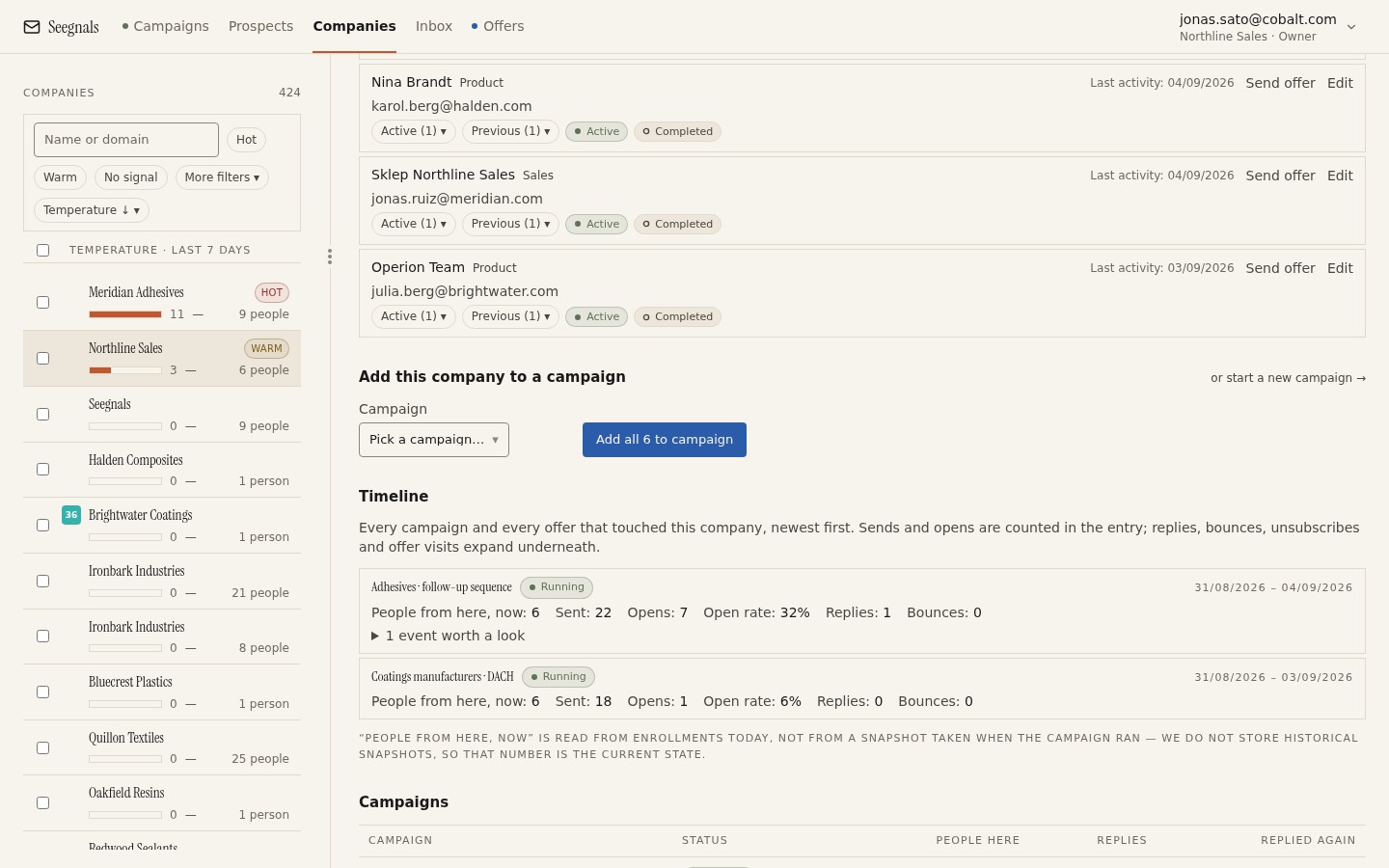 The offer view and the offer return sit in the same list as sends, opens and replies, so a forwarded proposal and a colleague suddenly opening your emails read as one story.
Say the timeline shows: you sent the proposal to the operations head on Monday; she opened it Monday afternoon; on Tuesday a new device read pricing and terms; on Tuesday evening the finance director, whom you had emailed cold three weeks earlier without response, opened that old email. The pieces fit. The proposal went to finance, and finance went looking for what else you had sent. You now know who the second reader almost certainly is, without any identity data from the link at all.
This is the argument for keeping proposals and outreach in one system rather than two. The individual events are ambiguous. The sequence is not. The company view page shows how the two sides sit together.
If the second reader is someone you never contacted, resist the urge to write to them directly. Go back to your recipient: “Happy to walk anyone on your side through the commercial section if that helps.” She knows who she forwarded it to. Let her make the introduction. When a colleague replies instead of your prospect covers the handling once they do.
Gating when you need to know exactly who
Inference is enough for most deals. For some it is not: proposals with sensitive pricing, regulated industries, or a buying committee where knowing exactly who has read the document changes what you do next.
For those, gate the link. The reader enters their email address and receives a one-time code; only then does the document open. Known addresses get in; unknown ones can request access, and you approve or decline. Every visit is then tied to a verified email rather than to a device fingerprint, and a forward shows up as a request from a new person rather than as an anonymous return.
The trade-off is friction. A gated link asks the reader to do something before they see anything, and a small number will not bother or will ask for a PDF instead. The full reasoning is in protecting a proposal link with a one-time code. The short version: gate when the cost of not knowing who read it exceeds the cost of a slightly slower first open.
Privacy and proportion
You are collecting behavioural data about people at work. Do it in proportion.
Say so. A sentence in your covering email telling the recipient the link opens in the browser and that you can see when it is viewed is both honest and disarming.
Do not narrate. Never tell a prospect what device their colleague used or which city a visit came from. Use the information to decide when and to whom you write, and keep the inference to yourself.
Do not over-read a single event. One unknown device is a hint. Two, with a distinct reading pattern and a coincident email open from a colleague, is a reasonable conclusion. Wait for a conclusion before you act.
Keep what you need and no more. Visit data serves the deal. When the deal is closed, it has done its job. Where the data lives and how it is protected is covered on the security page.
What to do this week
- Open the visit list for your last three proposals and mark each visit as return (same fingerprint) or possible forward (new one). Count the forwards.
- For each possible forward, look at the reading pattern and write down which role you think it was. Then check the company timeline for a coincident email open that confirms or contradicts it.
- Pick one proposal with a likely forward and send a short note to the original recipient offering to help whoever else is looking at it, without mentioning that you know someone is.
- Decide, for your own proposals, which ones carry information you would not want outside the company. Those are your candidates for gating.
- Add a sentence to your proposal email template saying the link opens in the browser and that you can see when it is opened.