The standard advice is to follow up on a proposal after three days, then a week, then two weeks. It is advice designed for a world where you know nothing about what happened to the document. If you can see when the proposal was opened, how far it was read, and whether anyone came back to it, following up on a calendar is like watering the garden on a schedule while standing in the rain.
Follow up on behaviour instead. Four signals cover almost every situation: the first open, a return visit, a stall or skip on a specific page, and silence. Each calls for a different message at a different time. This article works through them in turn, with what to send and what not to, and finishes with how to write these messages so they read as helpful rather than as evidence you were watching.
If tracked proposals are new to you, start with what happens after you send the PDF.
Calendar follow-ups versus behaviour follow-ups
A calendar follow-up says: it has been three days, I have no information, so I will ask you for some. “Did you have a chance to look at the proposal?” It puts the reporting burden on the prospect and it arrives at a time chosen by your diary rather than their attention.
A behaviour follow-up says: something just happened, so this is the moment you are thinking about us, and here is something useful. It arrives when the document is open or freshly closed, and it is specific because you know which part of the document was in play.
The second kind gets answered more often: you are writing into an existing moment of attention rather than trying to create one.
Behaviour follow-ups need three inputs, all of which a tracked proposal link records: the first open (with a notification to you), each visit with its time and progress, and reading time per page. Seegnals shows them on the offer’s detail page and summarises them in the offers list.
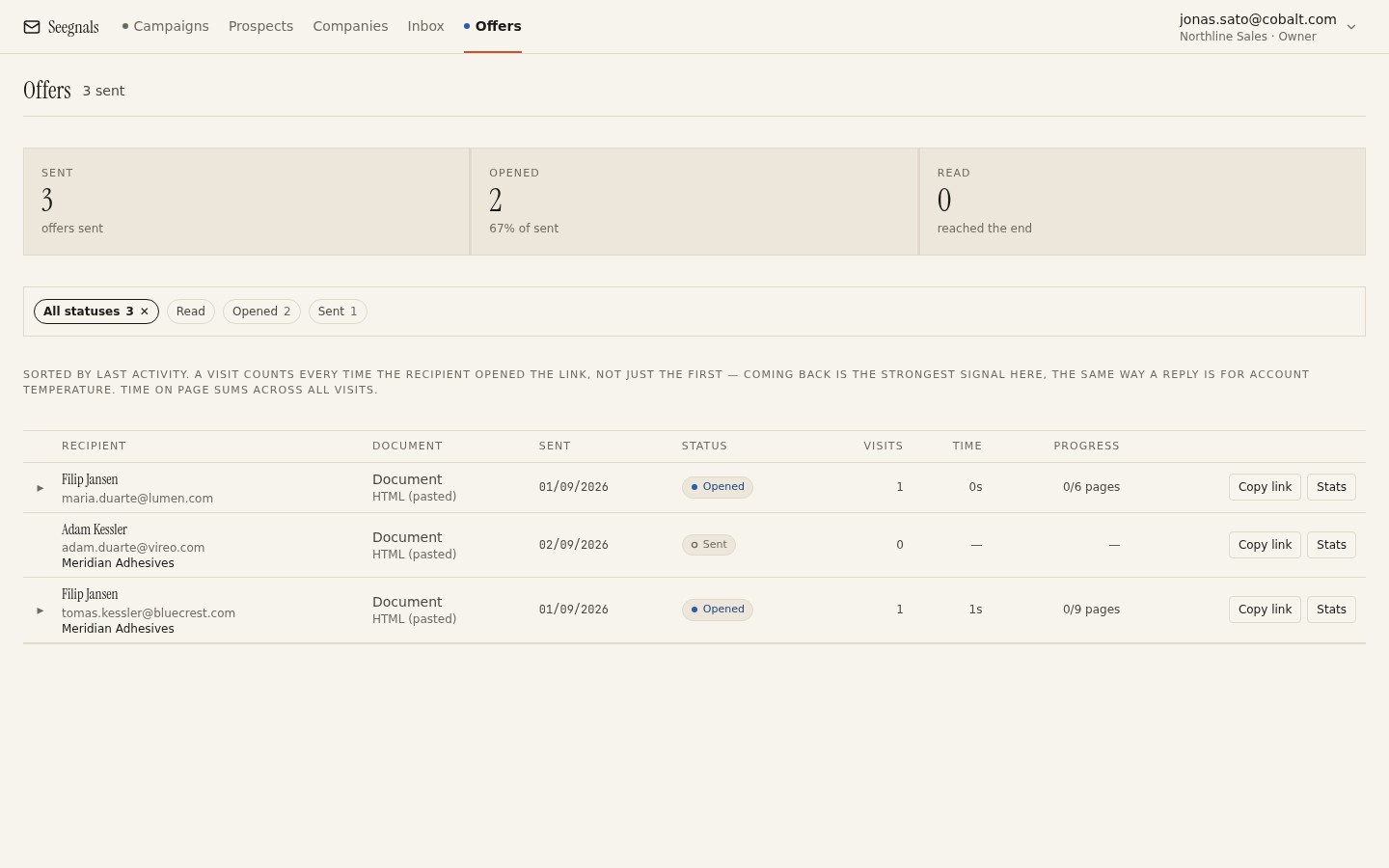 The list is your follow-up queue: Sent means the email is the problem, Opened means the first signal has fired, Read with several visits means someone is working with the document.
Signal one: the first open
The first open is the most reliable signal you will get, and the one with the shortest useful window.
What it tells you. The email arrived, the link works, and the recipient is looking at the document now. You receive a notification by email at that moment.
When to act. Not immediately. A message arriving while they are on page two says you are watching the door. Wait for the visit to end; the visit list shows its duration. Then, within the same working day if possible, send a short note.
What to send. Not “I see you opened it.” Something that assumes they have read it and offers the obvious next step: “Now that you have the proposal, would a fifteen-minute call to go through the implementation section be useful? I can also answer questions by email if that is easier.” It arrives when the document is fresh in their mind and gives them two easy paths.
What not to do. Do not ask whether they received it. They did. Do not ask whether they have questions in the abstract; offer a specific topic from the pages that got attention.
If the first open is on a phone, late in the evening, with a short duration, the reader skimmed. Wait for a second visit before treating it as read. If none comes within two working days, send the note anyway.
Signal two: a return visit
A return means the reader came back after an earlier visit. It is the strongest positive signal a document produces, because it means the proposal is being used rather than filed.
What it tells you depends on where they went. The visit list and per-page times answer that.
A return to pricing. They are checking the number, often before an internal discussion. Send a note offering to prepare a one-page summary of costs for whoever else needs it, or to join the internal conversation for ten minutes. You are offering to make their meeting easier.
A return to scope or implementation. They are checking whether it fits. Offer a specific clarification: “If it helps, I can sketch how the first month would look for your team.” Concrete beats general.
A return to terms. They are close, or procurement is involved. Offer to answer contract questions directly, and mention that your legal contact can talk to theirs. Speed here shortens the deal.
Several returns to the same page over a week. Comparison shopping. A note that says “if you are comparing options, I am happy to be direct about where we are stronger and where we are not” is unusual and often welcomed.
A return after weeks of silence. Something changed at their end. This is the one return that justifies a same-hour message: “I noticed the timing might have shifted; is there anything I should update in the proposal?” You are not narrating a visit; you are responding to a change.
The distinction between a return and a forward matters here, because a forward is a new reader and needs a different message. Who else opened your proposal shows how to tell them apart.
Signal three: a stall or a skip
Per-page reading time tells you where the reader stopped or lingered. Both are follow-up triggers.
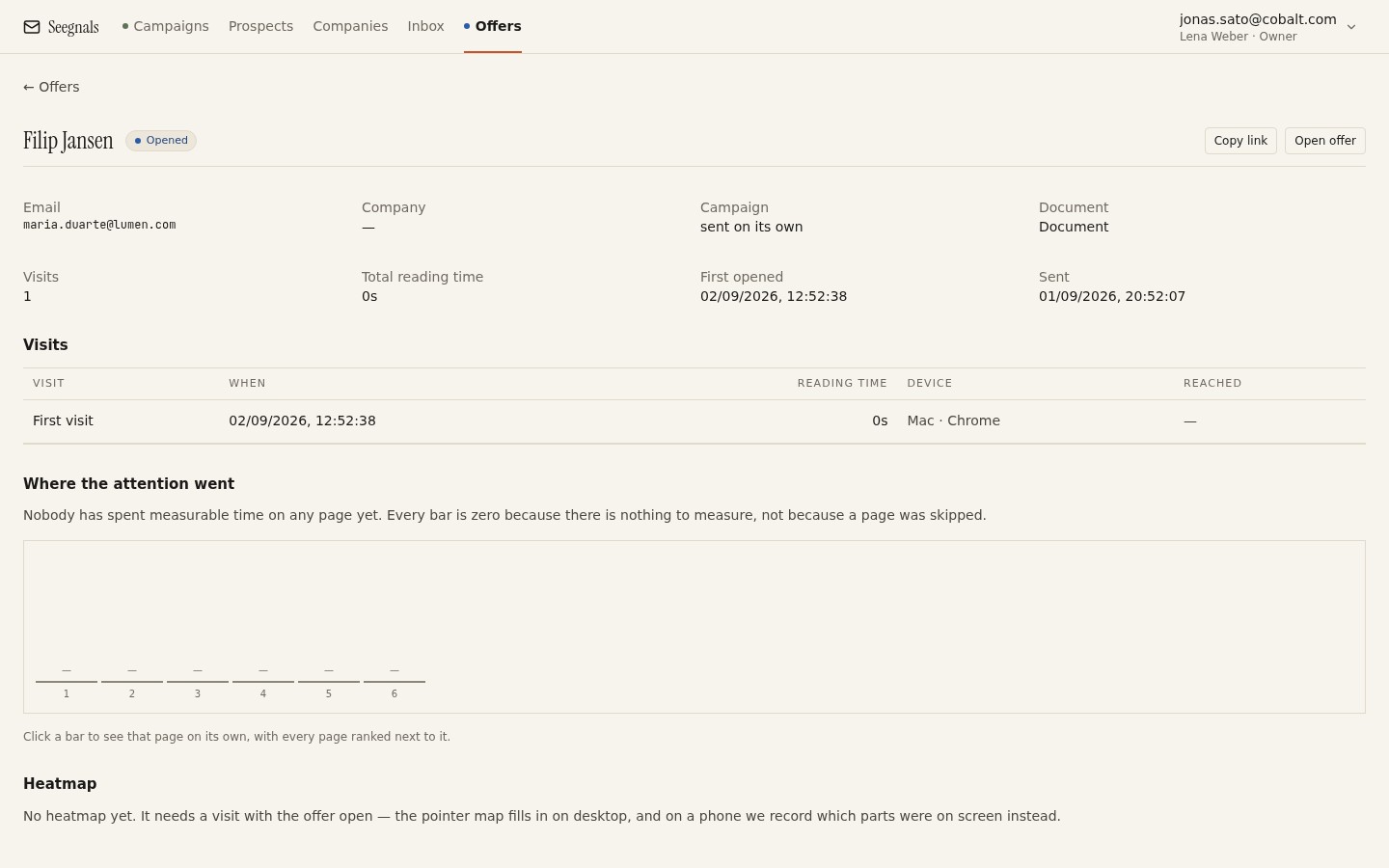 The page where the bars fall to nothing is where the reader left; the page that towers over its neighbours is where they had a question; both are places to aim the follow-up.
A stall before pricing. The reader did not reach the number. Either they ran out of time or the front of the document lost them. Follow up with the number itself, in one sentence, and an offer to talk. You are removing the reason they might not come back.
A stall right after pricing. They saw the number and stopped. It may have been enough (they are off to get approval) or too much (they are off to find alternatives). Follow up with a note that makes it easy to talk about price without making them raise it: “If the structure of the pricing does not quite fit how you budget, I can show a couple of other ways to shape it.”
A long stall on one page that is not pricing. A question you did not anticipate. Reread the page and guess the question, then answer it unprompted: “One thing I should have made clearer on the integration page is that this does not require changes on your side.” If you guess wrong, they will tell you the real question.
A skip of a section you thought mattered. If nobody reads the “about us” pages, that is feedback for the next proposal rather than a follow-up trigger. Reading time per page covers turning patterns into document changes.
A stall is a reason to write once. Send the one message that addresses it and wait for the next signal.
Signal four: silence
Silence has two versions, and they need different responses.
Sent but never opened. The problem is the email. Check whether the email itself was delivered and opened; on the company card the email events and the proposal events sit on the same timeline, so this is one glance. If the email was never opened, resend with a different subject line, or call. If the email was opened and the link was not, the link was the obstacle: say what it is in plainer words, and offer the PDF as an attachment. Why the two kinds of event live on one card is explained in why the company is the unit.
Opened, read, then nothing. The document did its job and the decision has moved somewhere you cannot see. After a reasonable interval, and with no new visits, a calendar-based follow-up is finally appropriate, because you have no behaviour to respond to. Keep it short and give them an easy exit: “If this has gone quiet on your side, tell me and I will stop chasing. If it is just timing, tell me when to come back.” People answer that because it costs them nothing.
Set the interval by how long the read took. A proposal read carefully across three visits and returned to twice deserves more patience than one skimmed once: the longer they engaged, the longer you wait before the silence message.
Writing the follow-up so it does not sound like surveillance
The data tells you when to write and what to write about. It must never appear in the message.
Never quote a number from the analytics, including the minutes, the page, the device and the city.
Never say “I saw that you”. Say “now that you have had a look”, “if it is useful”, “one thing I should have made clearer”.
Turn observations into offers. “They spent a long time on pricing” becomes “I can show a couple of other ways to shape the pricing”. “They forwarded it” becomes “happy to walk anyone else on your side through it”.
Keep it short. Three or four sentences. A follow-up longer than the page they were reading is a burden.
Send from the mailbox they know. The same sender across the outreach, the proposal and the follow-up makes the exchange feel like one person paying attention rather than a system reacting. If the proposal link is on your own domain as well, the picture is complete; white-label proposal links explains that side.
Tell them, once, that the link is trackable. A sentence in the covering email (“the link opens in your browser and lets us see when it is viewed, so we can time our follow-up sensibly”) makes every later message legitimate rather than uncanny.
What to do this week
- Make sure first-open notifications reach an inbox you watch and, for the next proposal you send, write the first-open follow-up in advance so it is ready when the notification arrives.
- Open the visit list for each live proposal and classify it: first open only, returns, stall, or silence. Write one follow-up per proposal, matched to the signal.
- Check every proposal with status Sent against the email that carried it. If the email was never opened, fix the email.
- Reread your last three follow-ups and remove every sentence that quotes or hints at analytics.
- Add the one-sentence tracking disclosure to your proposal email template.