Ask how long a proposal should be and you get two answers. The first is “as short as possible”, which is true and useless. The second is a number, which is invented and worse. The honest answer is that a proposal should be exactly as long as the list of questions the buyer needs answered before they can say yes, one page per question, and that list is different for every deal.
That gives you a test rather than a target. For every page, ask: which question of theirs does this answer? If you cannot name it, the page is length without purpose, and it will be skipped. Skipped pages are not neutral. They cost attention, they push the pages that matter further from the front, and they make the document feel like work.
This article is about applying that test. It covers what gets skipped and why, when to cut, how appendices let you be short without losing detail, and what the per-page reading data from tracked links can and cannot tell you about length. It follows on from how to structure a proposal, which sets the page order.
Length is a count of ideas
A page is one idea. That is the structural rule, and it turns the length question into a counting problem. How many ideas does this buyer need to decide?
For most small and mid-sized B2B deals the list looks like this: what the problem is and what you propose (one page), what is in scope (one), what it costs (one), how the work happens (one or two), who does it (one), why you (one), what is excluded (one), the terms (one or two). That is eight to ten pages, and for a simple deal some of them collapse into each other.
Notice what the list does not contain. It has no “about us” beyond the single “why you” page. It has no methodology chapter. It has no case studies as a section, though a single reference may appear on the “why you” page. Those are the pages that make proposals long, and they are long because they are written for the seller.
A deal with more questions gets more pages. A tender with a compliance matrix, a multi-site rollout with per-site variations, a deal with a regulatory element: each adds real questions and therefore real pages. Length is not the enemy. Pages that answer nothing are.
What gets skipped
Send enough proposals as tracked links and the same pages get skipped again and again, across readers and across deals. They fall into a few groups.
The company background. History, mission, values, headcount, offices. The reader knows who you are; they had a meeting with you. This page gets seconds, and it is usually near the front, so it costs the reader effort before they reach anything useful.
The methodology. Your five-phase approach, with a diagram. The reader wants to know what will happen and when; the name of your framework is not a question they have. Replace it with a timeline page that says what happens in each week.
Generic case studies. Three pages about clients in other industries with other problems. The reader looks for someone like them, does not find them, and moves on. One reference that matches their situation, in three lines on the “why you” page, does more than three pages that do not.
Feature lists. Every capability of the product, whether or not it relates to the problem on page one. The reader is buying a solution to that problem.
The covering letter reproduced as a page. It says what the email said. Skipped.
The table of contents. In a browser viewer the reader moves by page; a contents page is a page they page past.
Restatements. A page that repeats an earlier page in different words, usually because two sections were written by different people or at different times. The reader recognises it and skims, and the skim carries into the next page.
The common thread: each of these answers a question the seller wanted to be asked. The buyer did not ask it.
When to cut
Three tests, applied page by page.
The headline test. Write the headline of the page as a full sentence the buyer would want to be true. “The upgrade is live at all three sites within twelve weeks” passes. “Our approach” fails. A page that fails the headline test is either a label with content that belongs elsewhere, or a page with no idea. Cut it or fold it.
The question test. Name the question the buyer asked, in the meeting or in the brief, that this page answers. If you cannot, the page is speculative. Move it to the appendix if you think a particular reader might want it; otherwise remove it.
The repetition test. Read the page after the page before it. If a reader who read the previous page learns nothing new here, cut it.
Two things about cutting that people get wrong.
Cutting is not compressing. Squeezing three ideas on to one page to reduce the count does not shorten the proposal; it makes a dense page that gets skimmed. The reading effort is the same and the structure is worse. If three ideas are all needed, they are three pages.
Cutting the front is worth more than cutting the back. A skipped page at the front costs the reader effort before they reach anything they wanted. A skipped page at the back costs nothing; they have already decided. So when the count has to come down, look at pages two to four first. If the company background is there, that is the cut.
Appendices: short without losing detail
The fear behind long proposals is that a short one leaves something out that a reader will need. The answer is not to leave it out; it is to put it where the reader who needs it can find it and the reader who does not can ignore it.
That is the appendix. Anything a specialist might need and the decision-maker will not: the technical specification, the detailed project plan, the full terms and conditions, certificates, insurance, the long list of references, the compliance matrix. It is all in the document. It is all after the last page the decision-maker needs.
The main document should refer to the appendix by page where it matters (“full specification on page 14”) so that a reader with a question knows where to go. In a browser viewer they can jump there directly.
The appendix has one more use. It is where the pages you cut go when you are not sure. Cutting the methodology page feels like a loss; moving it to the appendix does not, and the reading data will tell you whether anyone ever visits it. If nobody does after ten proposals, it goes.
What the per-page data can and cannot tell you
Tracked proposal links record how long each page was on screen, per visit. Across several proposals this shows you what is read and what is skipped, and it is the best evidence you will get about your own documents. It is worth being precise about what it shows and what it does not.
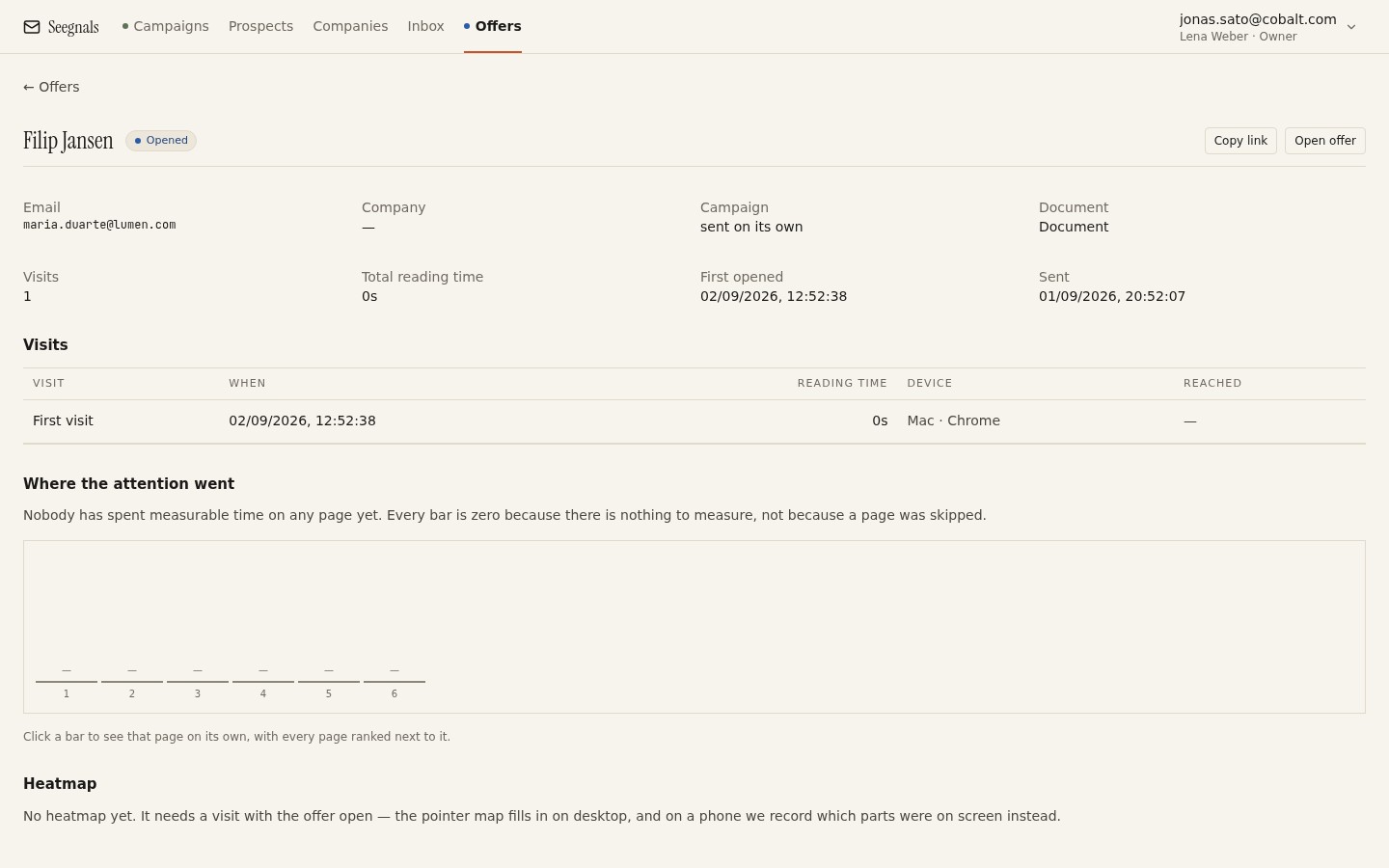 A page with no bar across several proposals is a page that answers no question; a page where the bars stop is where the reader gave up, and both are arguments about length.
It can tell you which pages are skipped by everyone. A page with no reading time across ten proposals is a page to cut or move. This is the single most useful fact for length.
It can tell you where reads stop. If readers consistently stop on the same page, and that page is not pricing, the pages before it were too many or the page itself is where they lost patience. Look at the count of pages before the stop.
It can tell you what holds attention late in the document. A back page that consistently gets time is one the reader needed; consider moving it forward.
It cannot tell you an ideal page count. There is no number in the data that says “eight is right”. The data is about pages.
It cannot separate “skipped because irrelevant” from “skipped because tired”. A page late in a long document may be skipped because the reader ran out of time rather than because the content was wrong. Move it forward once and see whether the time changes.
It cannot see the download. A reader who downloads the PDF and reads it offline leaves no page times. The offer still shows as opened, with the progress reached before the download.
And it needs several proposals to say anything. One reader skipping the timeline is a reader in a hurry. Ten readers skipping it is a page. The offers list is the place to see the pattern across documents; reading time per page goes into how to read the shape of each one, and the golden rules of sending offers guide covers the practice around it.
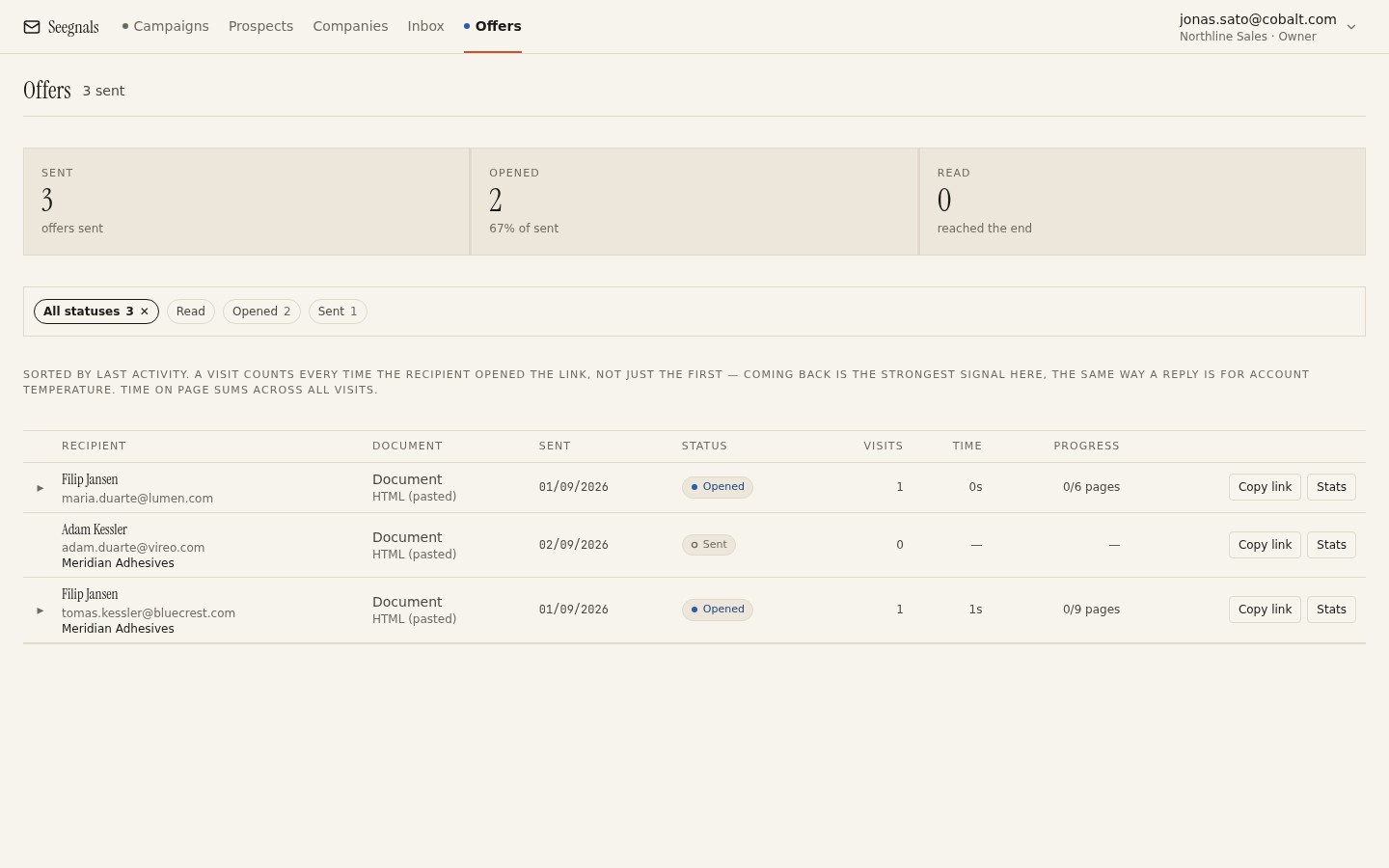 Progress through the document, across many offers, is the quickest length check: if most readers stop at the same fraction, the pages after that point are not being read.
In Seegnals the per-page bars, visits and returns sit on each offer’s detail page, and the list view shows progress and total reading time for every offer sent, so the cross-proposal comparison is a scroll rather than a spreadsheet.
What to do this week
- Take your standard proposal template and, for every page, write the buyer’s question it answers. Pages with no question move to the appendix.
- Apply the headline test to the pages that remain. Rewrite each headline as a sentence the buyer wants to be true, or cut the page.
- Look at pages two to four specifically. If any of them is background, methodology or a case study, move it back or out.
- Add page references from the main document to the appendix wherever a reader might want detail, so shortness does not read as omission.
- After the next ten tracked proposals, list the pages that got no reading time in any of them. Remove those pages from the template.