A proposal has twelve pages. The reader spent forty seconds on the cover, two minutes on the scope, eleven minutes on pricing and never reached the terms. Those four facts, laid out page by page as a heat map, are more informative than the fact that the proposal was “opened”. They are also easy to misread, because time is attention and attention has many causes.
This article explains what reading time per page measures, how to read the heat map, the patterns that come up repeatedly and what they usually mean, what the numbers cannot tell you, and how to turn what you learn into a better document rather than a cleverer follow-up.
If you are new to tracked proposals, what happens after you send the PDF covers the basics first.
What is measured, precisely
A tracked proposal link renders the PDF in the browser one page at a time. The page on screen is known, so the service records how long each page was visible before the reader moved on. Those durations are stored per visit and summed across visits into a total per page.
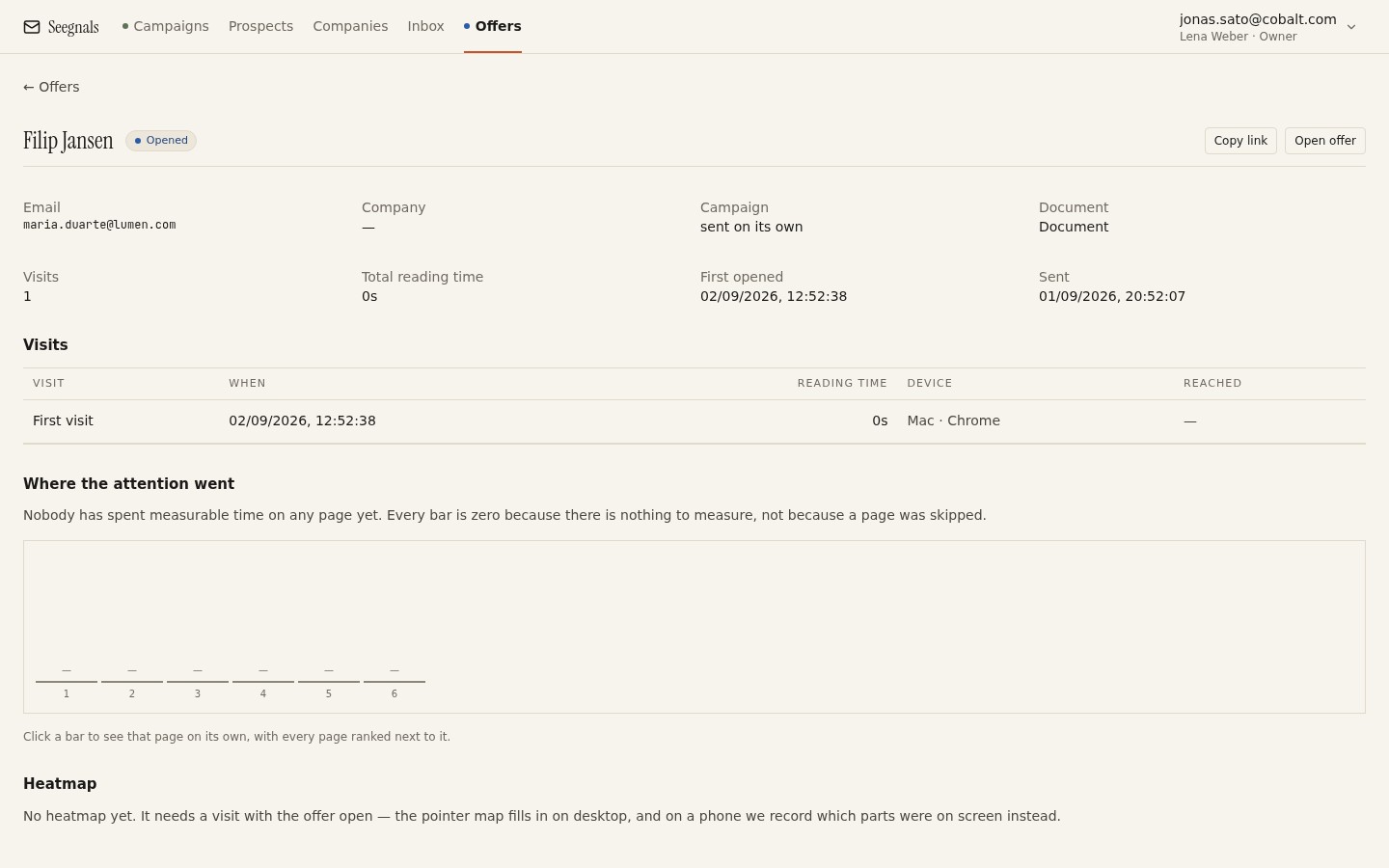 The bars are seconds of screen time per page, summed over every visit; taller means the page held the reader longer, and the visit list beneath tells you whether that was one sitting or several.
Three properties of the measurement matter for interpretation.
It measures visibility. A page on screen while the reader answers a phone call counts. A page read in two seconds because the reader already knew what it said counts as two seconds.
It measures the browser view only. If the reader downloads the PDF and reads the file, no page times are recorded for that reading. Progress and visits still show that the link was opened.
It sums across visits. A page with a high total may have been read once at length or four times briefly. The visit list resolves this, so read the heat map and the visit list together.
In Seegnals the detail page for each offer shows the per-page bars, the visit list with time, duration, device and how far the reader got, and the return count. The offers list summarises the same data as total reading time and progress.
Reading the heat map
Start with shape.
A flat profile, where every page got roughly similar time, means a linear read-through. The reader went from start to finish at a steady pace. This is common on a first visit and tells you the document was read, without telling you what mattered.
A single spike means one page held the reader far longer than the others. Look at which page. Pricing is the usual suspect, and a long time there is normal: people check numbers carefully. A spike on an unexpected page (a technical appendix, a clause in the terms) is a question the reader has that you did not anticipate.
A cliff, where time drops to nothing after a certain page, means the reader stopped. Where they stopped is your most important fact. Before pricing: they lost interest or ran out of time before the point. Right after pricing: the number did its job, positively or negatively, and they did not need the rest. In the terms: they are seriously evaluating and got interrupted, or hit something they did not like.
A double read, where the profile is broadly flat but two or three pages have roughly double the time, usually means a first read-through followed by a return to specific pages. Check the visit list to confirm there were two visits; if so, the pages with double time are the ones they came back for.
Zero on the last pages, with a high progress figure, means they scrolled to the end quickly. Skimming the back matter is normal and not a bad sign.
Common patterns and what they usually mean
Patterns repeat across proposals, and a few are worth memorising. These are interpretations rather than rules. The visit list and the account context decide.
Long pricing, nothing after. The number was the question. If they come back, the number was acceptable and they are now reading the rest. If they do not, the number was the answer. Your follow-up should make it easy to discuss the number without making them say so first.
Long scope, short pricing. They are checking whether you understood the problem. Price is not their concern yet, or someone else owns it. Follow up on the scope.
Long on one case or reference page. They are looking for someone like them. If that page describes a company in their industry, good. If it does not, the next version of your proposal should.
Fast everywhere, then a return the next day to pricing and terms. Classic pre-meeting behaviour: someone is about to discuss it internally and is checking the two things they will be asked about. This is the moment to offer to join that discussion. When to follow up based on reads covers the timing.
Two devices, two profiles. A phone visit that skims and a desktop visit that reads carefully are the same person in two contexts. Two desktop visits with different profiles, hours apart, may be two people. Who else opened your proposal goes into forwards and returns.
What the numbers cannot tell you
Reading time is one of the most useful signals in the sales process and one of the easiest to over-interpret. A few limits to keep in mind.
It cannot distinguish confusion from interest. Eleven minutes on pricing might mean they are working out the total for three sites, or that the table is unclear. Both deserve the same follow-up: an offer to walk through it.
It cannot see intent to buy. A reader who finishes every page may be doing due diligence on a decision already made against you. A reader who stops at pricing may have already decided for you and gone to get approval. Time tells you where attention went.
It cannot correct for interruptions. One very long page time in a single visit, especially on a page that is not pricing, is probably a break. Compare across visits before you draw conclusions.
It cannot see the print-out. If they printed the document, the paper is unmeasured. A visit that ends shortly after a print or download is a reader who prefers paper. Follow up as if they read it all.
It cannot tell you why the document was not opened. That is an email problem, and the tracking on the email side (delivered, opened, clicked) is where to look. The two sides sit together on the company card so you do not have to guess which. Why that card is organised around the company is explained in why the company is the unit.
Use the pattern to rewrite the document itself
The most valuable use of per-page data is the least glamorous: making the next proposal better.
Cut what nobody reads. If the “about us” section gets seconds across twenty proposals, it is doing nothing at the front of the document. Move it to the back or drop it.
Expand what they linger on. If the implementation timeline consistently holds attention, it is answering a question they have. Give it more room, more detail, a clearer diagram.
Put pricing where it is looked for. Readers who jump straight to pricing and then read backwards are telling you the document order is wrong for them. Consider a one-page summary with the number on page two.
Fix the cliff. If reads consistently die on the same page, that page is the problem. It may be too dense, or it answers a question they did not ask. Rewrite it and see whether the cliff moves.
Check against outcomes. Once you have a handful of won and lost proposals, compare their profiles. If won deals show a return to the terms page and lost deals do not, the terms are where the decision happens for your buyers, and the terms page deserves your best writing.
None of this needs statistics. A dozen proposals and an honest look are enough to see the pattern in your own documents.
What to do this week
- Open the detail page for your three most recent proposals and sketch the shape of each: flat, spike, cliff or double read. Write the shape and the page number down.
- For any cliff, reread the page where the reader stopped as if you were them. Change one thing on it.
- Compare the page you spent longest writing with the page that got the most reading time. If they differ, ask yourself why.
- Write your next follow-up after looking at the heat map, and check it contains no numbers from the heat map.
- Set up a simple note per proposal: shape, follow-up sent, outcome. After ten, read the notes together.