Most proposals are structured the way the seller thinks: company background first, then a long description of the approach, then the price on the second-to-last page, then terms. The buyer reads the opposite way. They open the file on a screen, decide within the first page whether it is worth their time, jump to the price, and then, if the number is acceptable, go back and read what they are paying for.
A proposal that gets read is built for that reader. The first page carries the whole argument. Each page after it holds one idea, so skimming works. The price sits early, on its own page, next to the options. Terms and background go where they belong, at the back, for the people who need them.
This article walks through that structure page by page, then shows what the per-page reading data looks like when the structure works and when it does not. If you send proposals as tracked links, you already have the data; if not, what happens after you send the PDF explains where it comes from.
The first page carries the whole document
A buyer with six proposals on their desk gives each of them a page. If the first page does not tell them what you propose, what it will do for them and roughly what it costs, they either put it aside or start hunting. Either way you have lost control of the order in which the document is read.
So the first page is a summary, written last and placed first. It has four parts, each a sentence or two.
The problem, in the buyer’s words. Not your reading of their situation but the sentence they used in the meeting. If they said “our quoting takes four days and we lose jobs to faster suppliers”, that sentence goes on page one.
The outcome. What is different when the work is done. One measurable thing if you have one, one plain description if you do not.
The shape of the answer. Two or three lines on what you will actually do. Not the method, the deliverable.
The price, or its range, and the time. If there are options, name the range: “from X to Y depending on the option chosen on page 4”. The buyer will find the number anyway; giving it to them here keeps them reading in your order rather than theirs.
There is a separate article on what belongs on the first page of an offer that goes into the writing of it. For structure, the point is simply that this page exists and that everything after it exists to support it.
One idea per page
A PDF read in a browser is read one page at a time. The reader sees a page, forms an impression, moves on. If a page holds three ideas, the impression is “dense”, and the reader skims. If it holds one idea with a headline that states it, the reader gets the idea even if they only read the headline.
This gives you a simple test for every page: can you write its headline as a complete sentence that a buyer would want to be true? “The scope covers three sites and one integration” is a headline. “Scope” is a label. Labels force the reader to read the page to find out what it says; headlines let them choose.
One idea per page also means splitting things you would naturally keep together. Scope and exclusions are two pages, because “what you get” and “what you do not get” are different ideas and the reader will want to come back to the second one on its own. The timeline and the team are two pages. Pricing and payment terms are two pages, and the second one belongs with the legal terms at the back.
The payoff comes later, when you look at the reading data. If each page is one idea, reading time per page tells you which ideas held attention. If pages are mixed, the data is mixed too and you learn nothing.
Where the price goes
The price goes early, on its own page, after the summary and the scope. Not at the end.
The argument for the end is that the reader should understand the value before they see the cost. In practice the reader does not cooperate. They jump to the number, read it without the context you built, and then read the value pages already knowing whether they think it is expensive. Putting the price late does not delay the judgement; it only removes your framing from it.
Putting it early, after one page of summary and one of scope, means the reader meets the number with the problem and the outcome fresh in mind. That is the best framing you will get.
The pricing page itself is one idea: the number and what it buys. Options sit side by side on the same page so the comparison is visual. Payment schedule, invoicing, currency and validity go on a terms page at the back. There is a full article on how to present the number on the pricing page; for structure, the rule is: one page, early, options together, administration elsewhere.
The order that works for most proposals
Put the pages in the order of the buyer’s questions. For most small and mid-sized B2B deals that order is:
- Summary: problem, outcome, shape, price range. One page.
- Scope: what is included, in their terms. One page.
- Pricing: the number, the options, what each includes. One page.
- How it happens: phases, dates, what you need from them. One or two pages.
- Who does it: the people, in one line each, and why they are the right ones. One page.
- Why you: the two or three facts that make you credible for this problem. One page.
- Exclusions and assumptions. One page.
- Terms: payment, validity, cancellation, liability. One or two pages.
- Appendix: anything a specialist might need and the decision-maker will not.
Notice what is missing from the front: the company history, the mission statement, the list of every client. They are not answers to any question the buyer is asking on page one. If they matter to a particular buyer, they are in the appendix and the buyer will find them.
Notice also that “why you” comes after “how” and “who”. By the time the reader reaches it they have seen the plan and the people; the credentials confirm a judgement they are already forming rather than trying to create one from nothing.
What reading time per page then shows
Once a proposal is structured this way and sent as a tracked link, the per-page reading time becomes readable. Each page is one idea, so the time on each page is attention to that idea.
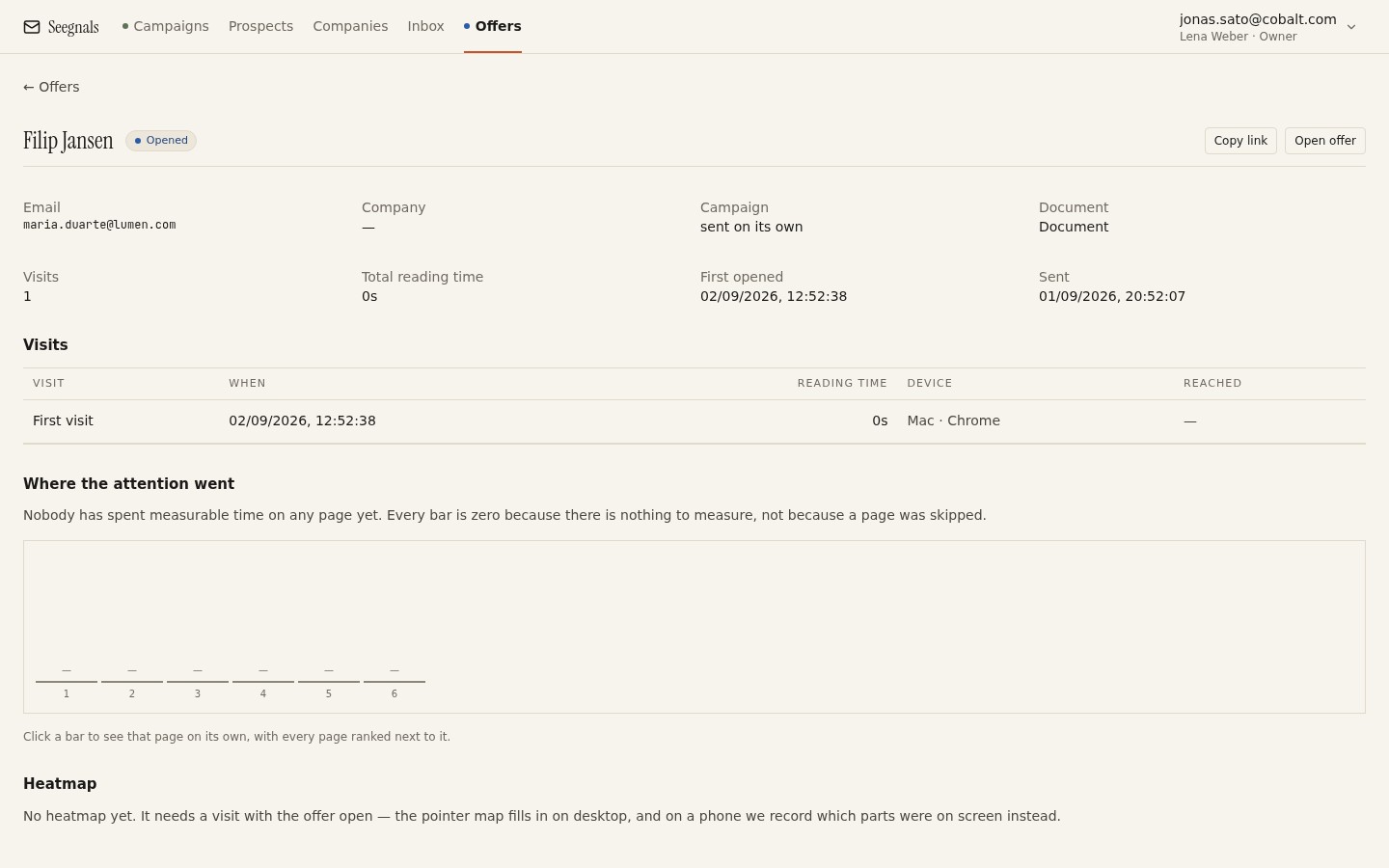 Each bar is the time one page was on screen, summed over visits; when every page holds a single idea, a tall bar is a question and a missing bar is a page that did not earn its place.
A few things you will see, and what they say about structure rather than about the deal.
The summary page holds time on every proposal. Good. If it does not, the page is not doing its job; it is probably a cover with a logo rather than a summary.
The pricing page holds time. Also good, and expected. If it holds time and nothing after it is read, the number ended the conversation, which is information you would rather have than not. The reading time per page article covers how to read that pattern.
A page in the middle that gets seconds from everyone is a page that is answering a question nobody asked. Move it to the appendix or cut it.
A page late in the document that gets a return visit is a page the buyer needs for a conversation with someone else. Check which. If it is the exclusions page, your scope page is not clear enough. If it is the team page, someone is asking who they will be dealing with. That is a reason to give the team page more room next time.
Reads that die on the same page across proposals mean that page is the problem. It is either too dense, or it sits before the answer the reader wants and they gave up waiting.
The comparison across proposals matters more than any single one. One reader skipping the timeline is a busy reader. Ten readers skipping it is a structural fault.
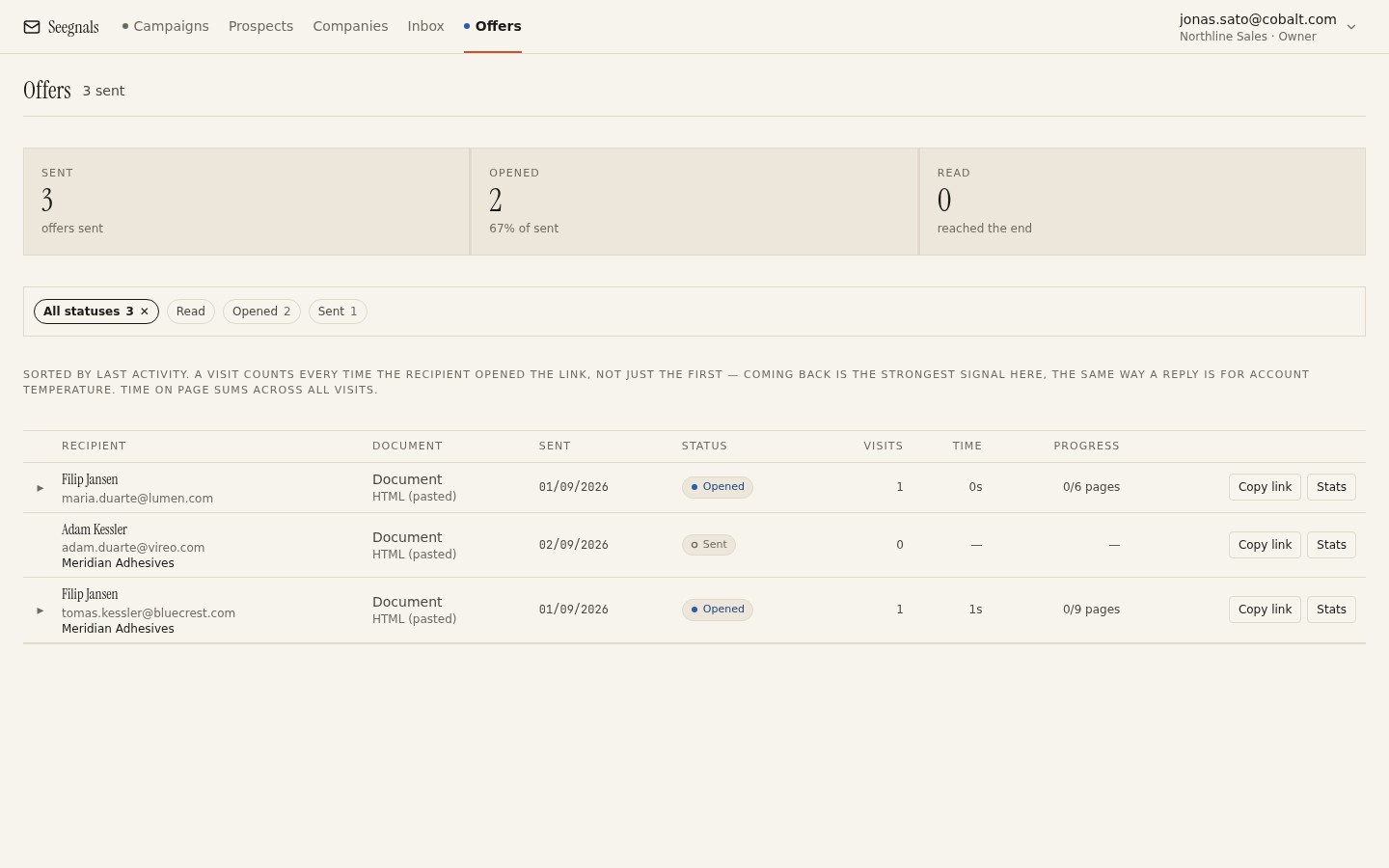 The list view across proposals is where structural faults show: a document that everyone reads to the same point and no further has a page problem.
In Seegnals this data sits on the offer detail page and, in summary, on the offers list. It also appears on the company card alongside the email events, so a proposal opened but never read is easy to tell apart from one that was never opened at all. The golden rules of sending offers guide covers the sending side.
What to do this week
- Take your most recent proposal and write the headline of each page as a full sentence. Any page where you cannot is two ideas or none; split it or cut it.
- Write a one-page summary for it: problem in their words, outcome, shape, price range. Put it first. Remove the cover if the cover is only a logo.
- Move the pricing page to position three. Move payment terms off it and on to the terms page.
- Move the company background and the client list to the appendix. Keep the two or three facts that matter for this buyer on a single “why us” page.
- Send the next five proposals as tracked links and, after they have been read, note which page each reader stopped on. If it is the same page, change that page.