You can write a good email to the wrong person and nothing happens. You can write an average email to the right person and get a meeting. Choosing the recipient is not a step before the real work; for a small B2B team, it is most of the real work.
The right person is the one who feels the problem your product solves, has the standing to do something about it, and is not so senior that a cold message from an unknown company is filtered out before it is read. That is usually not one person but two or three at each company, and the order you approach them in matters as much as who they are.
This piece covers how to get from your product to a set of roles, how seniority changes the answer by company size, how to sequence several people at one account, and what to look at in the company view before you write to the next one.
Work back from the decision you change
Databases let you filter by title, so the temptation is to start there: pick “Head of Operations”, export a thousand rows, go. The problem is that the same title means different things at a forty-person firm and a four-thousand-person one, and that the person who would actually champion your product often has a title you did not think to search for.
Start instead from the decision. What changes at a customer when they buy from you? Who notices the problem today? Who pays for the fix? Who has to approve, install or live with it? Write those down as three or four roles in plain words: the person who runs the line that stops, the person whose budget covers maintenance, the person in IT who has to say yes to a new supplier.
Only then translate roles into titles, and do it per segment. The person who runs the line is a production manager in one industry and a site lead in another. The budget owner might be an operations director, a plant manager or, in a small firm, the owner. Keep a short table of role to likely titles for each segment you work. It will save you from writing to a “Head of Growth” who turns out to run the newsletter.
Seniority: one above, one below
The most common mistake is writing too high. A founder or managing director at a company with three hundred staff receives a stream of cold email and delegates most of it unread. The second most common mistake is writing too low: a junior analyst who agrees with every word and can do nothing about it.
A useful rule is to aim one level above the person who feels the problem and one level below the person who signs. If a production planner feels the pain, write to the production manager. If the finance director signs, write to the head of operations who reports to them. These people know the problem is real, can start an internal conversation, and are not yet filtered by an assistant.
Company size bends this rule.
Under about twenty people, the owner is usually the right first contact. There is often no layer between the problem and the decision, and an owner who cares will reply personally.
Between twenty and a few hundred, the department head or director is the sweet spot. They own a number, they have budget or influence over it, and they are reachable.
Above a few hundred, treat business units or sites as separate companies. The head of one plant does not speak for another, and a group-level executive rarely opens cold mail. Write to the site or unit leadership and let the account grow from there.
Several people at one company
Writing to more than one person at a company is normal and often necessary. The person who feels the problem and the person who owns the budget see it differently, and a message that fits one will miss the other. The question is how to do it without the account noticing it is being worked as a list.
Three habits keep it honest.
Give each role its own angle. The operator gets a message about the daily problem. The director gets a message about the outcome and its cost. The gatekeeper, if you include one, gets a short note that removes an objection they would raise later. If the messages differ only in the first name, you are not writing to roles, you are mail-merging.
Stagger the entry. Put the first person into the sequence, wait a few working days, then add the second. Two colleagues receiving the same opener on the same morning compare notes at lunch and both file it as spam. The reasoning and the numbers are in how many people to contact in one company.
Keep one sender per account. If your campaign rotates across mailboxes, make sure each prospect stays on the mailbox that first wrote to them, so the thread holds. Three colleagues hearing from three different people at your firm in one week looks disorganised. Rotation is covered in mailbox rotation explained.
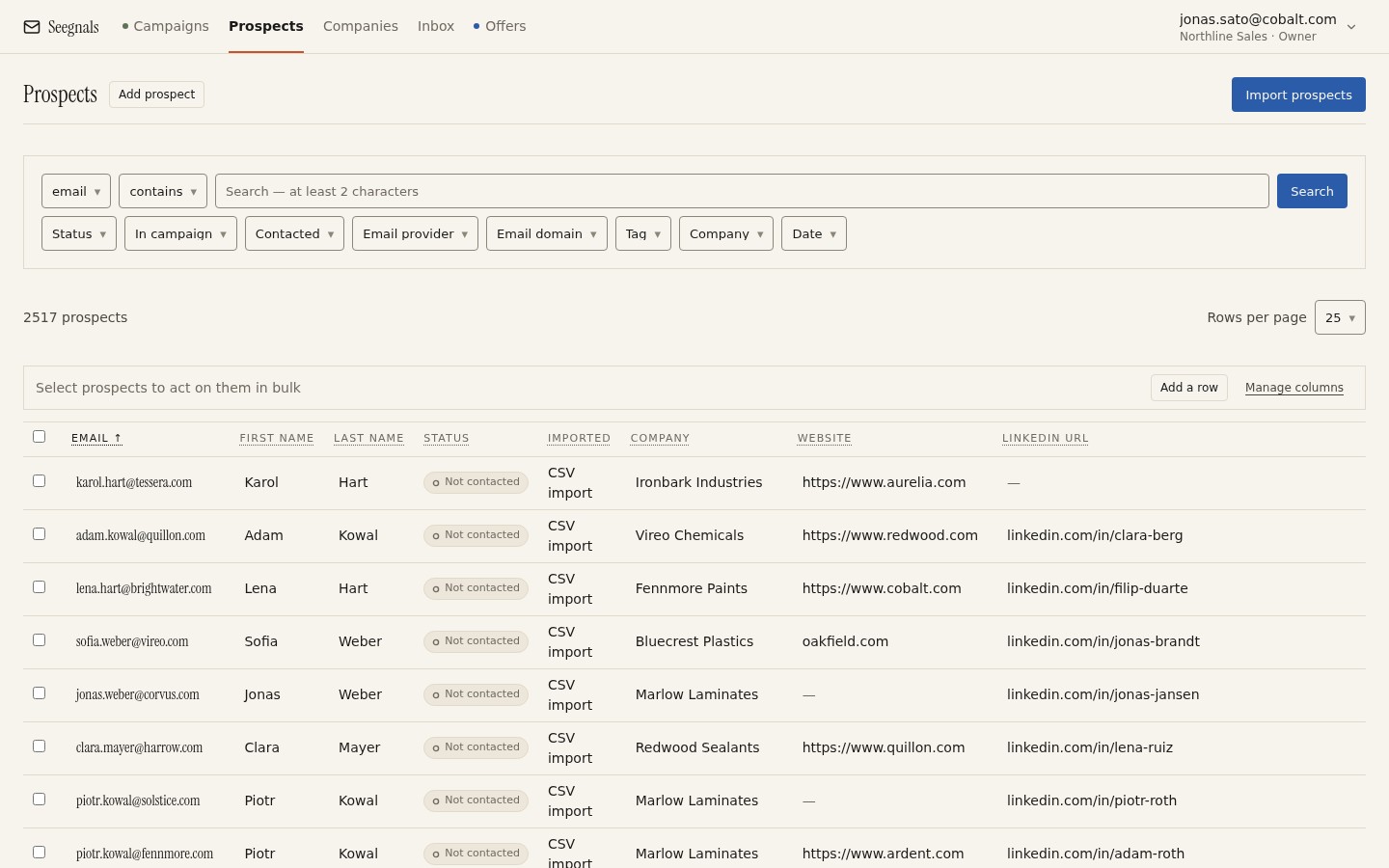 A role column, filled on import, is what lets you see later which roles actually answer and which you can stop writing to.
Record the role as a custom field when you import the list. It costs one column in the CSV. It lets you write a snippet that references the role’s problem, and, more usefully, it lets you filter the prospects table by role afterwards and see who replied. Over a few campaigns that filter tells you more about your buyer than any persona document. The mechanics are in personalisation with snippets and custom fields.
What the company view shows you before you write
The single most useful thing before writing to the second or third person at an account is to look at what the first one did. Did they open? Click? Reply with a polite no? Forward it to someone who then visited the site? Each of those changes what you should write next, and to whom.
This is where thinking in companies rather than contacts pays off. In Seegnals every prospect belongs to a company by email domain, and the company card shows all the people you have there, a timeline of events across campaigns (sent, opened, clicked, replied, offer viewed, offer returned), and a temperature that rises with engagement. Before adding the director, you can see that the operator opened twice and clicked once but did not reply. That is a warm account with the wrong first contact, and the message to the director can say so: “I wrote to your colleague in production last week about…”
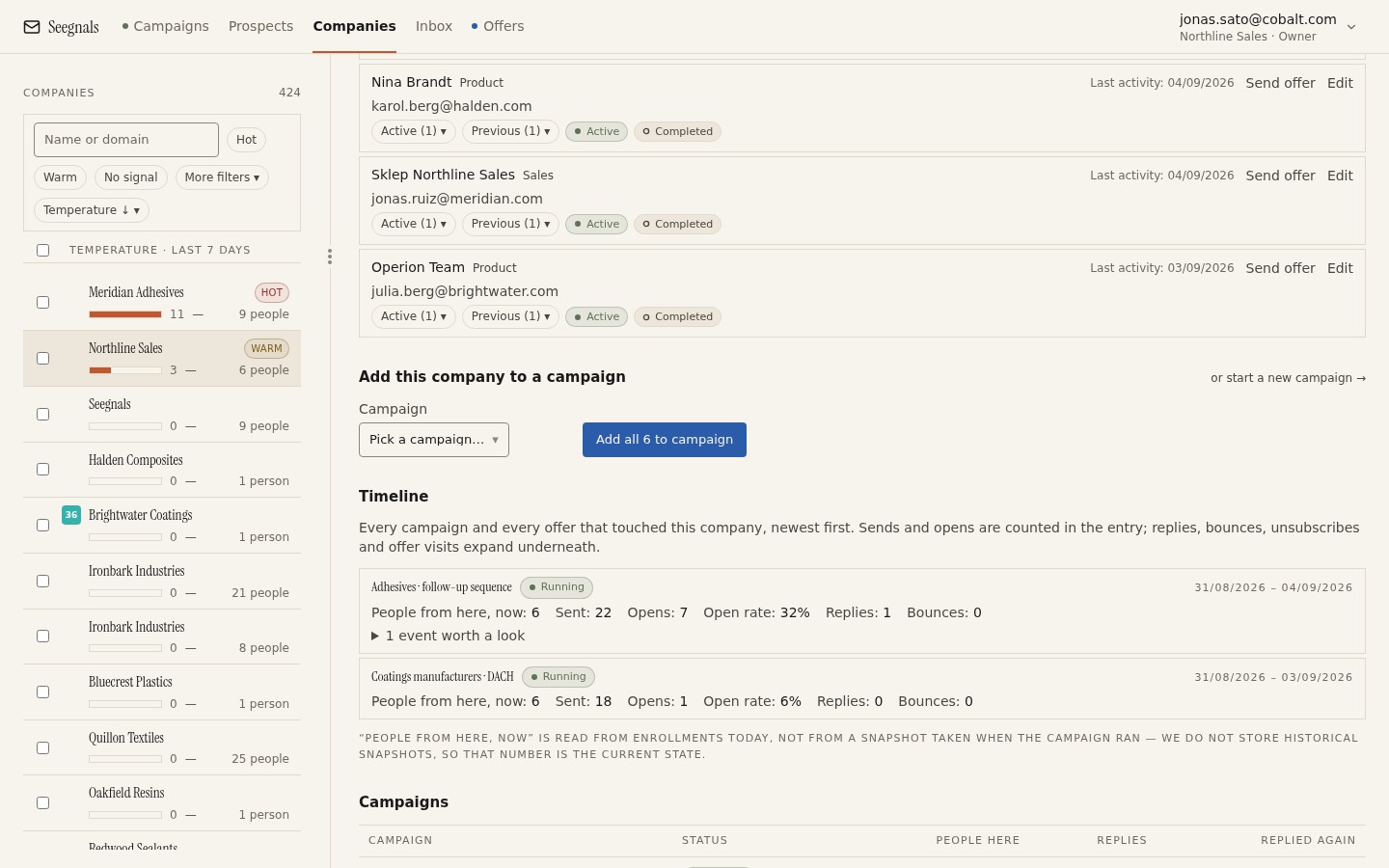 Before writing to the next person at an account, the card shows who else there has already seen your emails and what they did with them.
Three patterns are worth recognising.
Opens with no reply from the operator. The problem is probably real but the person cannot act. Move up one level with a message that references the earlier email.
A reply from someone you did not write to. Your email was forwarded. That person is now your best contact and the account is warm; when a colleague replies instead of your prospect covers what to do.
Nothing at all from two people. Either the addresses are wrong, the mail is not landing, or the segment is wrong for this company. Check delivery first, then stop the account rather than adding a fourth person.
The dashboard lists the hottest companies, so the accounts where several people are engaging float to the top without anyone building a report. What to do when an account heats up is its own subject: hottest companies.
When the right person is not in the database
Sometimes the role you want is not on any list, or the database gives you a title without a name. Do not fall back to whoever is listed. A few minutes on the company website, the team page and public professional profiles usually surfaces the person who runs the thing you sell into. If it does not, write to the department head and ask; a short, honest “who at your company looks after X” gets more replies than people expect, and it is the least embarrassing kind of first line. More on that in first lines that are not embarrassing.
Whatever you do, verify the address before it goes into a campaign. A guessed address that bounces costs your domain more than a skipped prospect costs your pipeline. Verification on import, including catch-all detection, holds unverifiable addresses in the To check queue before the first send so you can fix or skip them.
What to do this week
- Write down the decision your product triggers and the three or four roles involved in it, in plain words, before you open any database.
- For each segment you work, map those roles to two or three likely titles and note the seniority rule: one above the pain, one below the signature.
- Add a role column to your next import and map it to a custom field.
- Pick five accounts where the first contact opened but did not reply, look at the company card, and write to the next role with a sentence that references the first email.
- Find one account where two people received the same opener on the same day, and fix the entry timing for the next batch.