Two people, one product, a target list of a few thousand companies. You do not have a sales operations person, a CRM administrator or the time to maintain a nine-stage pipeline with weighted probabilities. What you have is a shared inbox, a spreadsheet that used to be accurate, and a growing sense that deals are slipping through gaps neither of you can see.
A sales process for a team this size is not a smaller version of an enterprise one. It is a different thing: fewer stages, defined hard enough that either of you can tell where any company is in ten seconds, and a weekly rhythm that keeps the two of you looking at the same picture. The unit of the process is the company, because that is what you are trying to win.
This article gives you five stages with entry and exit definitions you can actually run, explains what the company card replaces (most of the spreadsheet), and sets the weekly rhythm that holds it together. It pairs with the account-based outbound playbook for small teams, which covers how to fill the top of this process.
Why fewer stages, defined harder
Most pipelines fail small teams for two reasons. They have too many stages, so companies sit in “Qualified” or “Nurturing” for months because nobody knows what would move them. And the stages are defined by feelings (“they seem interested”) rather than by events (“someone at the company replied and asked a question about scope”).
With two people, you cannot afford ambiguity, because there is no manager to arbitrate and no weekly pipeline meeting long enough to relitigate every deal. Each stage needs an entry event that either of you would recognise without discussion, and an exit that is equally plain. If you cannot name the event, the stage is decoration.
The other thing small teams cannot afford is a process that lives in a tool only one of you updates. The process has to run on the objects you already touch every day: the campaign, the inbox, the company card.
The five stages
Here are five stages that fit a two-person B2B team selling to companies, with the event that moves a company into each.
1. Targeted. The company is on a list and at least one person there is in a campaign or about to be. Entry: the company appears in your workspace with a prospect attached. Exit: any reply, or the sequence completes with nothing. Companies here are not deals; they are work in progress for the input side of the team.
2. Engaged. Someone at the company replied, or the company’s activity crossed a line you set (several people opening, a click, a proposal viewed). Entry: a reply classified as Interested or Maybe later, or a temperature you have decided counts. Exit: a conversation booked, or a Not interested reply that closes the company for a period. This is where the output side of the team takes over.
3. In conversation. A call or a substantive email exchange has happened, and you understand their situation well enough to describe it in two sentences. Entry: the first real conversation. Exit: a proposal sent, or a decision that there is no fit yet.
4. Proposal out. A proposal has been sent as a personal link and you are following up on reads. Entry: the link goes out. Exit: a signature, a clear no, or the third follow-up unanswered. How to follow up on an unanswered proposal without nagging covers the follow-up sequence and the stopping rule.
5. Closed. Won, lost, or silent. Every closed company gets a one-line reason and a date to look again, because in a market of a few thousand companies, every lost account is a future prospect.
Five stages, each with an event. Note what is missing: “Qualified”, “Negotiation” and percentages are all absent. Qualification happens inside stages two and three, as a question you answer (do they fit, can they buy, is now plausible) rather than a stage a company waits in. Negotiation is part of stage four.
What the company card replaces
The spreadsheet a two-person team keeps is usually trying to do three jobs: remember who was contacted, remember what happened, and decide who to talk to next. All three are jobs the company card does better, because it is fed by the events themselves rather than by someone remembering to type them in.
In Seegnals, every prospect belongs to a company by email domain, and the company card shows every person you have contacted there, a timeline of events across all campaigns (sent, opened, clicked, replied, offer viewed, offer returned), and a temperature that rises with engagement. Why the company is the unit explains the reasoning.
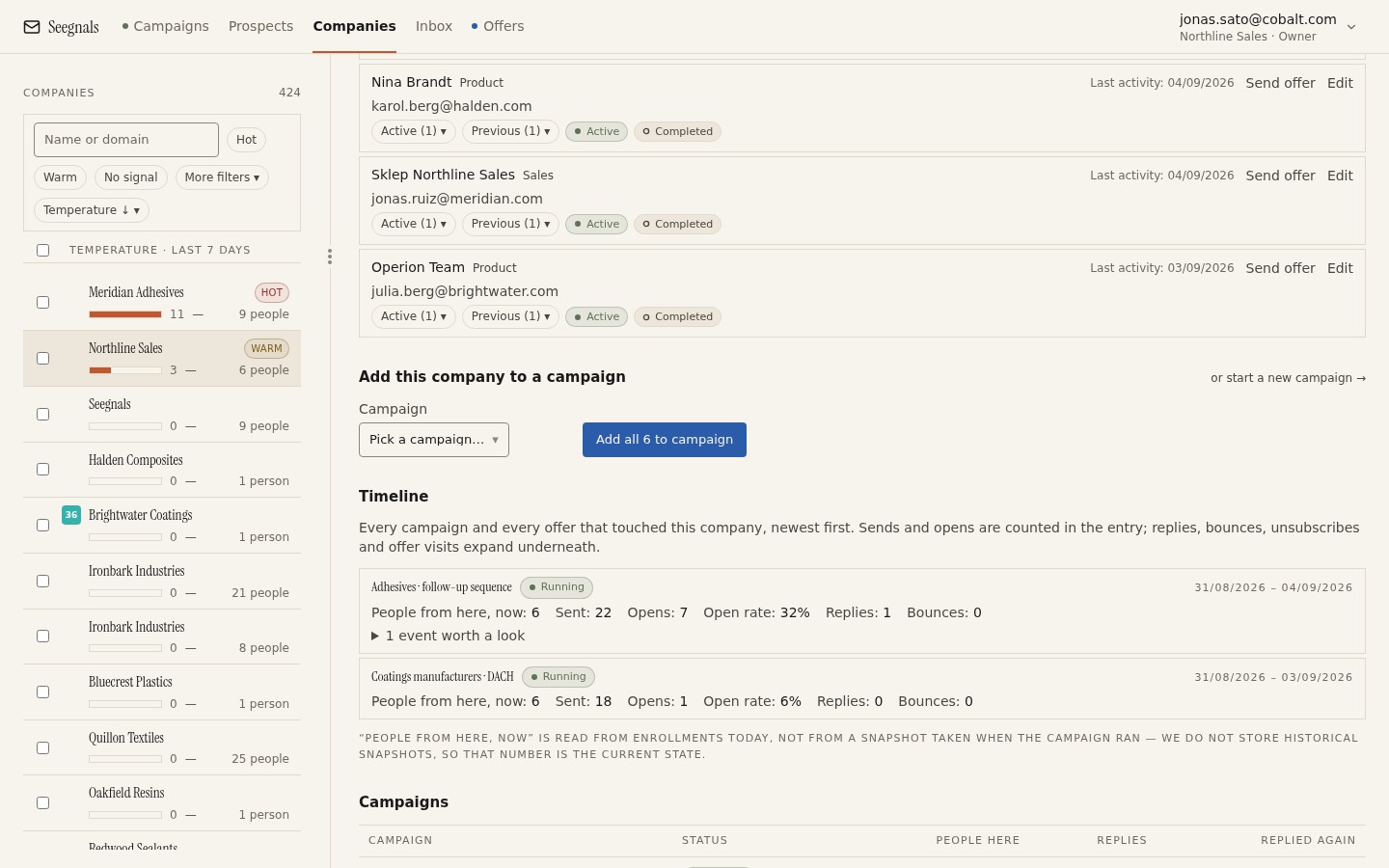 The card is the stage record. Whether a company is Targeted, Engaged or past a proposal is readable from the timeline without anyone having updated a field.
Mapped to the stages:
Who was contacted is the people list on the card. Before writing to a second person at a company, you can see the first one was already written to twice and never replied, which changes what you say. How many people to contact in one company covers the pattern.
What happened is the timeline. A reply from the operations lead, a proposal opened by someone whose email you did not have, a return visit to pricing: they sit in one list in time order, which is exactly what you need before a call.
Who to talk to next is temperature. The dashboard lists the hottest companies, so the output side of the team starts each day from a ranked list rather than from memory. Company temperature explains how it is read and what it misses.
What the card does not replace: the two-sentence description of their situation, the reason a deal was lost, the date to come back. Those are judgements, and they go in your CRM or in a note. The card tells you what happened; you still have to write down what it means. If you use a CRM, replies and their classification are pushed there as notes and activities on the matching person and organisation, so the two records stay in step.
Handoffs when there are two of you
The weekly rhythm article proposes splitting the work by object: one person owns lists, campaigns and deliverability; the other owns the inbox, conversations and accounts. In stage terms, person A owns Targeted, person B owns everything from Engaged onward, and the handoff is a classified reply.
Make the handoff explicit. When a reply lands and is classified as Interested or Maybe later, the sequence stops for that person automatically, and B picks it up from the inbox with the company context beside the thread. A does not chase it; B does not go back and edit campaigns. The line is clear because the event is clear.
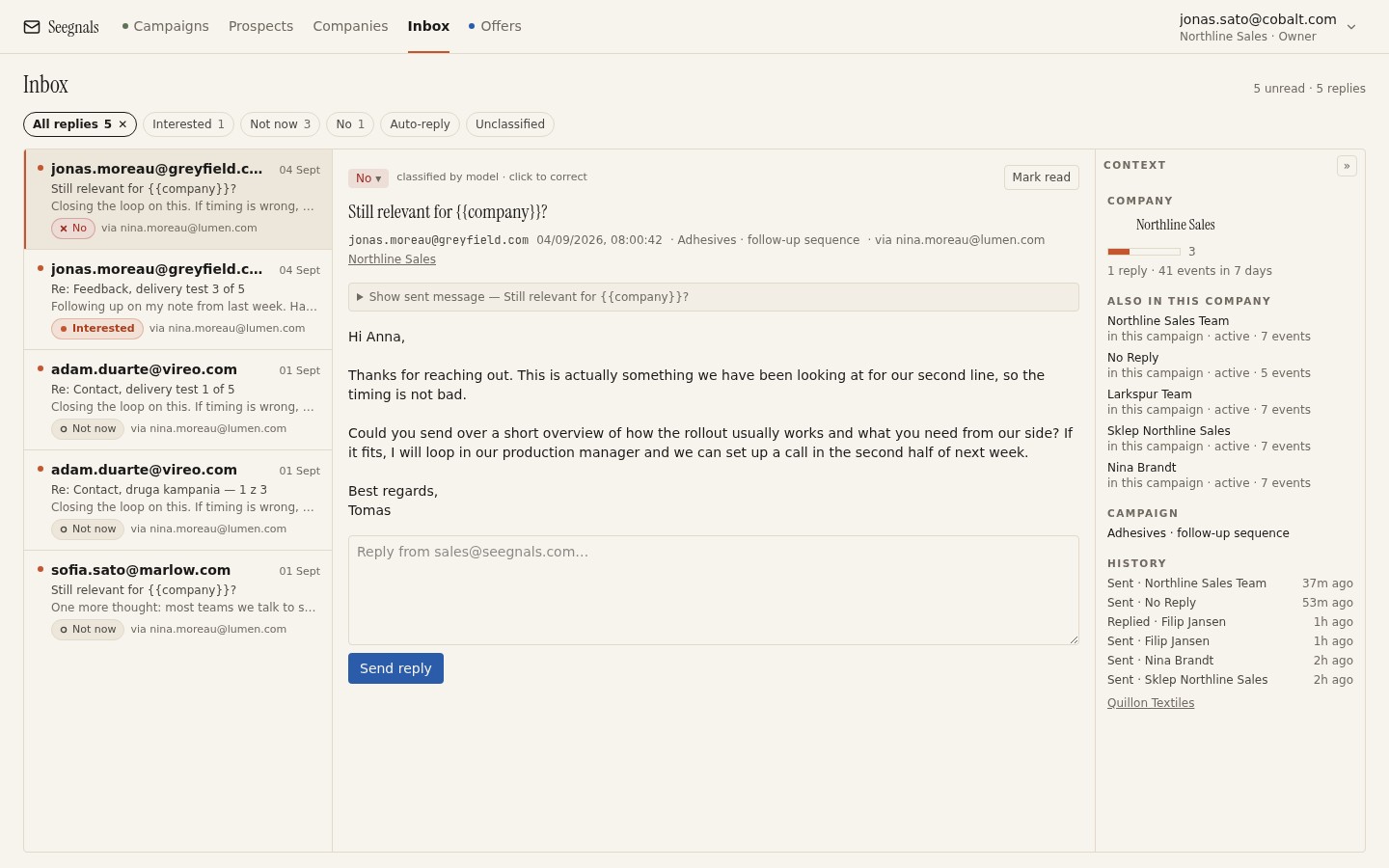 The handoff point. A reply arrives classified; the company card sits beside it; the person who owns conversations takes it from here.
The reverse handoff matters too. When B learns something on a call that should change the campaign (a segment that does not fit, a subject line that got mentioned, a job title that turned out to be the wrong buyer), it goes on the Friday review list rather than into a chat message at 3pm that A will forget. Sorting replies into Interested, Maybe later and Not now covers what each class means for the next action.
The weekly rhythm, in stage terms
The rhythm itself is set out day by day in the weekly rhythm article. Here is how it maps to the stages.
Monday: A prepares the list and moves new companies into Targeted. B clears the weekend inbox and moves companies into Engaged where replies came in.
Tuesday: A launches. B works Engaged companies: answers, proposes calls, books them. When to move from email to a call is the relevant judgement.
Wednesday and Thursday: B runs conversations and sends proposals, which is stage three and four work. A watches deliverability and the To check queue.
Friday: both review. Per stage, how many companies entered and left this week, and why. One decision per campaign for A; one decision per stuck company for B. Write both down.
Numbers worth counting
With five stages defined by events, a small number of counts tell you whether the process is working, and none of them is reply rate. Reply rate is the wrong north star explains why.
Count companies entering Engaged each week. This is what the input side produces.
Count companies moving from Engaged to In conversation, and how long it took. This is the output side’s first job and the place small teams leak most: a warm reply that waits three days cools.
Count proposals out and proposals closed, with reasons. Over a quarter, the reasons tell you more about your offer than any survey.
Count companies in each stage older than a threshold you set. Anything in Engaged for over two weeks without a conversation is either not engaged or being neglected; the card will tell you which.
Four counts, once a week, on the Friday review. They fit on one line each.
What to do this week
- Write the five stage definitions on one page, with the entry event for each, and agree them between the two of you. Delete any stage you cannot define by an event.
- Open the Companies view and, for every company with any activity, decide its stage from the timeline. Note how many the spreadsheet had wrong.
- Agree the handoff: which reply classes move a company to the output side, and that the sequence stopping is the signal.
- Set the four weekly counts up as a Friday habit, on paper if nothing else, and take the first reading this Friday.
- For every company already Closed, write the one-line reason and the date to look again.