Two people, a handful of mailboxes, a target market of a few thousand companies. There is no SDR manager and no operations person, and outbound cannot become a full-time job for either of you. The work still has to happen every week or the pipeline dries up in a month.
What makes this sustainable is not effort but shape. When each day has one job and each person owns one side of the process, outbound becomes a routine rather than a series of decisions. Below is a weekly rhythm that fits two people with other responsibilities, organised around the objects a cold email operation actually has: lists, campaigns, the inbox, companies and the numbers.
Split the work by object
Before the week, split the roles. The mistake is to split by task (“you write, I send”), which leaves both people half-informed about everything. Split by object instead.
Person A owns the input side. Lists and imports, sequences and their copy, campaign launches, mailboxes and deliverability, the campaign statistics. When a campaign pauses itself because of bounces, A gets the notification and deals with it.
Person B owns the output side. The inbox, classifying and answering replies, follow-up conversations, the companies that are heating up, the CRM. When a prospect asks for a call, B books it.
Both own the dashboard. The dashboard in Seegnals shows usage against plan, the hottest companies and what needs attention. Both people open it at the start of the day; it is the shared surface that stops the two sides drifting apart.
Invite each other into the workspace with the right roles (owner and member in Seegnals, invitations by email), and agree that the roles are about accountability rather than permission: either of you can do anything, but one of you is the person who notices when it has not been done.
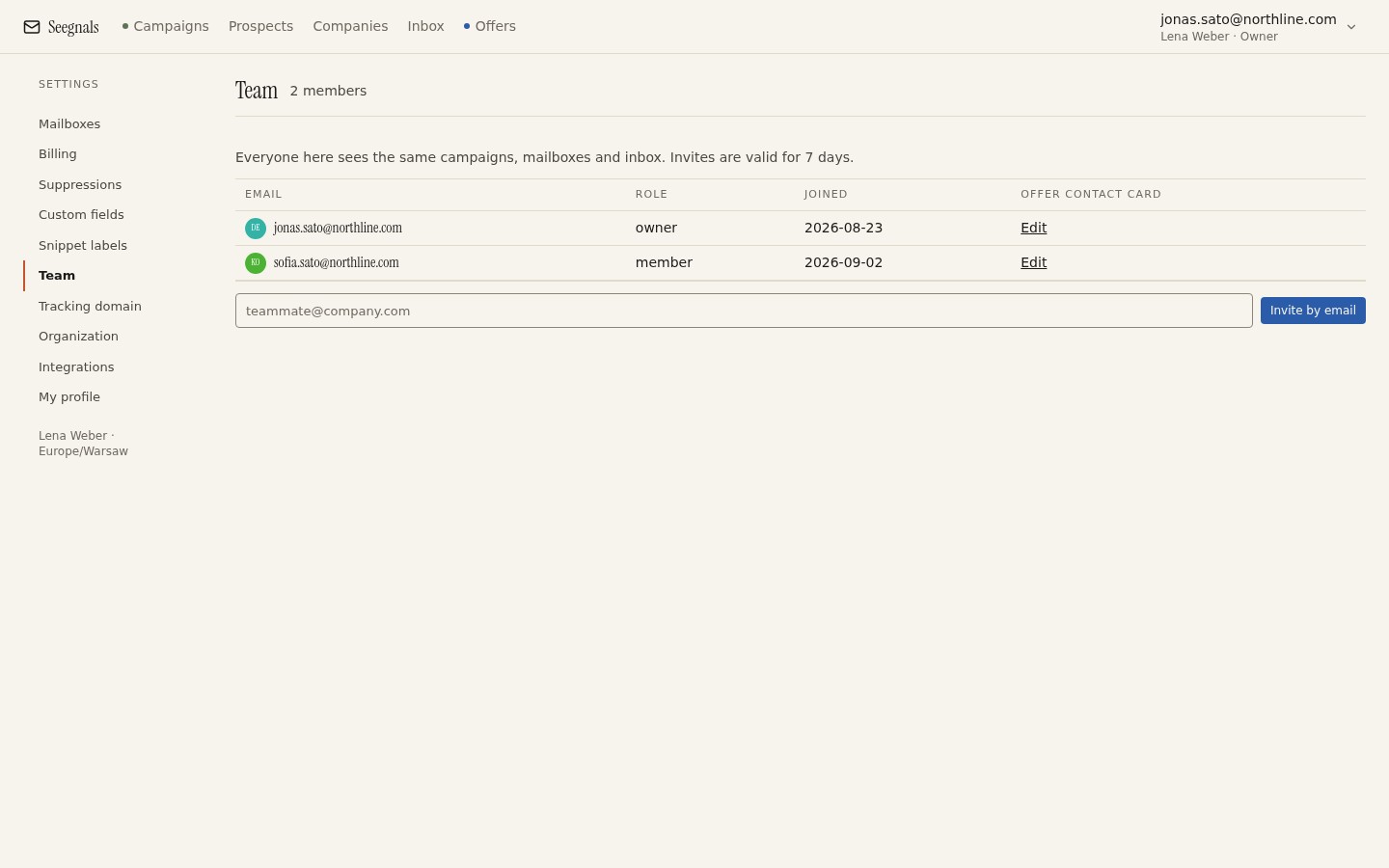 Two members, one workspace. The role setting records who is accountable for what.
Monday: lists and preparation
Monday is for the input side, and it belongs to A.
The job is to prepare the week’s list. Run the list quality checklist: file shape, verification, duplicates by email and by company, suppression screening, personalisation columns filled, segment fit confirmed on twenty random rows. Import, and clear the To check queue deliberately.
If a sequence needs writing or rewriting for this segment, Monday is also when that happens, with Friday’s review notes open. Keep the rules from how many follow-ups belong in a sequence to hand: three to five steps, widening gaps, every step with a reason, a closing step.
Meanwhile B does the Monday inbox: replies from the weekend, out-of-office messages that arrived after Friday’s sends, anything that needs a same-day answer.
Tuesday: launch day
Launch new campaigns on one day a week, and make it Tuesday. Two reasons. First, a Tuesday launch gives the first step three working days to collect bounces, autoreplies and early replies before the weekend, so Friday’s review has something to read. Second, launching everything on one day means the first-day noise from all campaigns arrives together and can be triaged together, rather than trickling in and interrupting every day.
A launches with the checklist: sending window set in the prospect’s timezone, weekdays and working hours; mailboxes picked and their daily limits confirmed against the list size; bounce shield threshold set; a test send to yourself from a real record; To check queue empty.
A quick piece of arithmetic worth doing every launch day: mailboxes times daily limit equals your daily capacity. Three mailboxes at 30 a day is 90 a day. A list of 450 people with a five-step sequence will take longer than a week to work through, because follow-ups share the same capacity. Set expectations accordingly rather than adding mailboxes on impulse; the reasoning is in daily sending limits per mailbox.
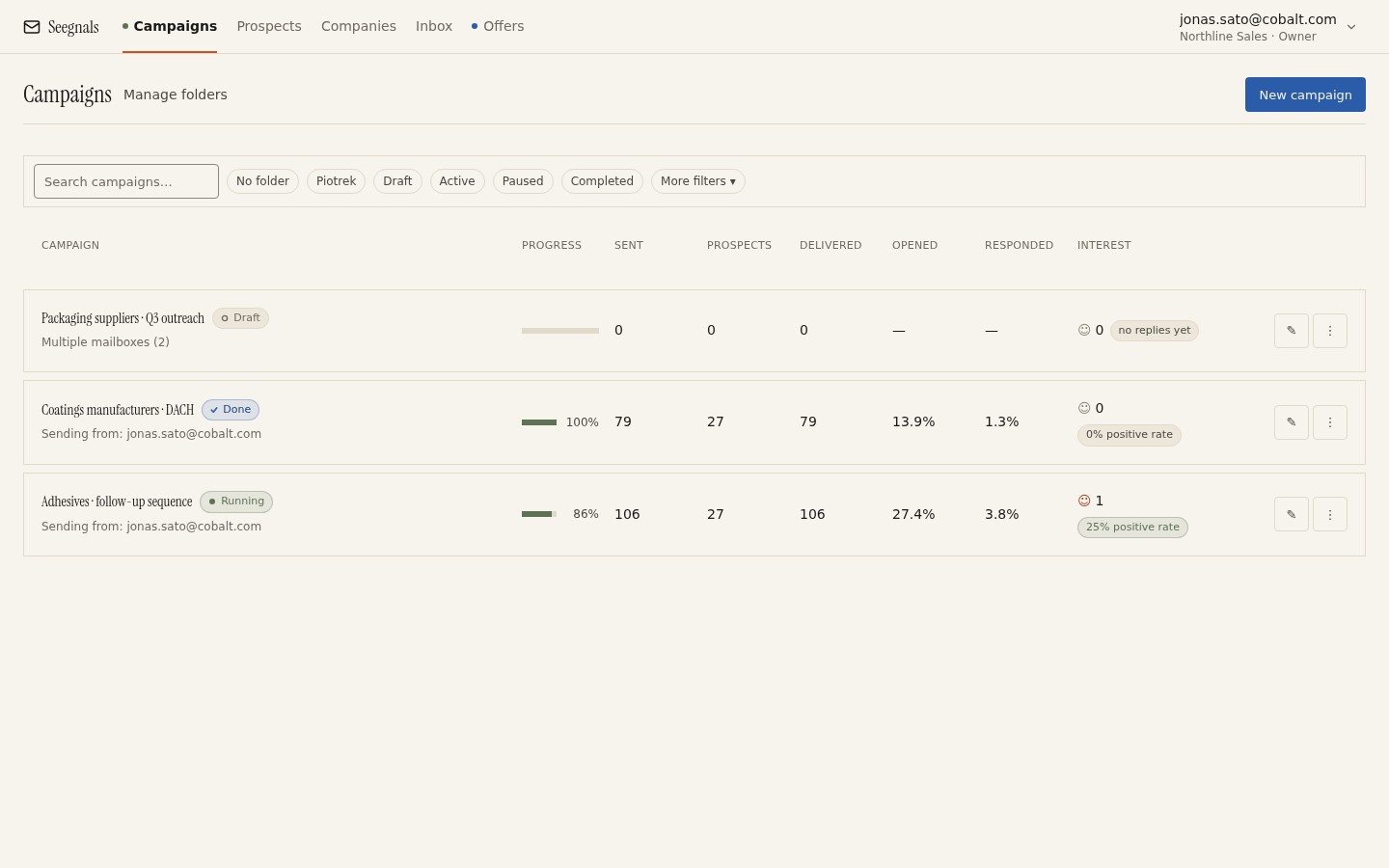 After launch day the campaigns list is the shared view: which campaigns are Running, which are Paused, and how far each has got.
Every day: the inbox, twice
The inbox is B’s daily job and the one that most directly affects revenue. A warm reply that waits two days is noticeably cooler when answered.
Check it at two fixed times, say mid-morning and late afternoon, and clear it each time to zero unclassified replies. Clearing means each reply has a class (Interested, Maybe later, Not interested, Autoreply / Out of office, Bounce, Unsubscribe request, Other) and a next action. The decision rules are in sorting replies into interested, maybe later or not now; the daily discipline is simply that no reply is left in Other overnight and no Interested is left unanswered past the working day.
Seegnals classifies replies automatically and stops the sequence for that person, so B’s job is to read every reply, correct any class that is wrong, and answer the ones that need answering. Twice a day is enough; the classifier handles the stopping in between.
A watches a different thing daily: the campaigns list for anything Paused. A campaign paused by the bounce shield is a list problem that needs fixing before it resumes, and it should not wait for Friday.
Every day: the hottest companies
The second daily job, also B’s, takes ten minutes. Open the dashboard, look at the hottest companies, and for each one that has moved up since yesterday ask a single question: what is the next human action at this account?
A company heats up when several events accumulate across its people: opens, clicks, replies, an offer viewed or returned. Because Seegnals aggregates every prospect into a company by email domain, the dashboard shows accounts rather than individuals. The article on what to do when an account heats up covers the playbook; the rhythm point is that this check is daily, brief and B’s.
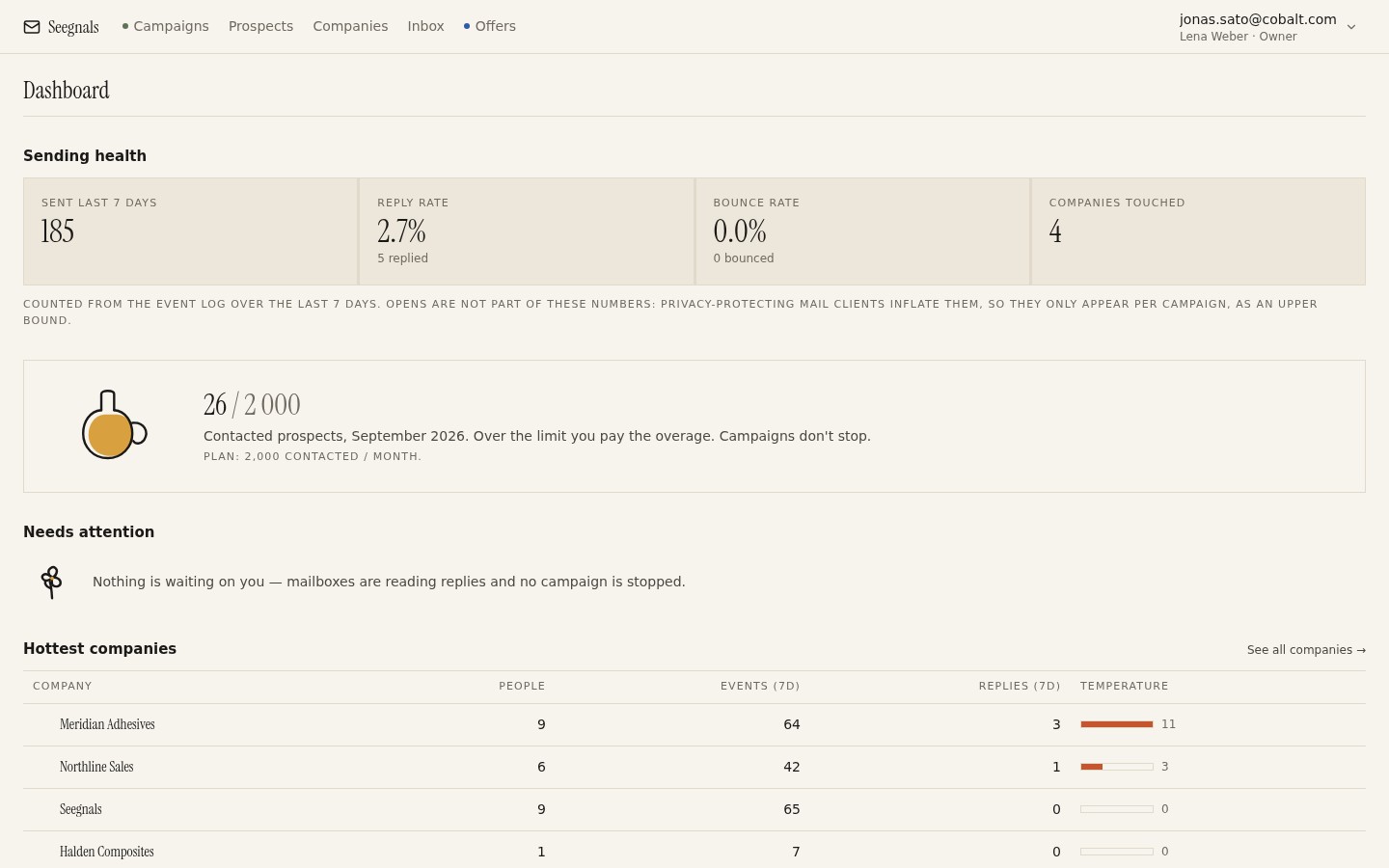 The dashboard is the shared morning view. Hottest companies is B’s list for the day; what needs attention is A’s.
Wednesday and Thursday: the middle of the week
The middle of the week is where the sequence does its work and the team does theirs.
For A, midweek is for maintenance rather than new launches: watching the guardrails on running campaigns (Bounced, Opted out, Autoreplied relative to Sent), checking the Deliverability tab for any domain whose SPF, DKIM or DMARC status has changed, and preparing next Monday’s list if the current one is running down. If a campaign’s held-back queue has grown because a later step needs a field the import did not have, A fixes the records.
For B, midweek is conversations. Interested replies become calls; Maybe later replies get dates; redirects become new prospects with fresh openers. If you use a proposal document, this is when offers go out and B watches the reading statistics to time the follow-up.
Neither day has a launch. If a list is ready on Wednesday, it waits for Tuesday. The exception is a small, urgent segment where the cost of waiting is real; even then, launch it in the morning so the first day’s signals arrive before you leave.
Friday: the review
Friday afternoon, both people, forty-five minutes, with the campaign statistics open. The agenda is fixed.
- Per campaign, interested replies per hundred contacted. This is the primary number. Not reply rate; the reasons are in reply rate is the wrong north star.
- Per campaign, the guardrails. Bounced, Opted out, Autoreplied, and the share of the list that was held as unknown. Anything that moved gets a cause.
- Per step. Where did the interested replies come from, and where did the opt-outs cluster? Where a step has variants, read the variant table by Interested first.
- Companies in conversation. How many entered that state this week, and what is the next action at each. This is the number you would give anyone who asked how outbound is going.
- One decision per campaign. Shorten, lengthen, rewrite a step, change a segment, or leave it alone. Written down, with the reasoning, in a shared document.
Export the statistics as CSV at the end of the review so the numbers survive independently of the tool.
The review is also where the roles get checked: did anything fall between A and B this week? If a reply waited, or a paused campaign sat for two days, the rhythm has a gap and the fix is to name whose job it was.
Holidays and absence
Two people means that any absence halves the team. Decide in advance who covers what: B away means A does the inbox twice a day and skips Monday’s list preparation if necessary; A away means B leaves campaigns running but launches nothing new. Both keep the daily dashboard check.
Never let the inbox go unread for a working day. A running campaign keeps generating replies whether anyone is there or not, and the bounce shield will pause a campaign on its own but will not answer a prospect who wants to talk.
What to do this week
- Agree the split: one person owns lists, campaigns, mailboxes and statistics; the other owns the inbox, conversations, companies and the CRM. Write it down.
- Put the fixed times in both calendars: two inbox checks a day, a Monday list block, a Tuesday launch block, a Friday review.
- Move any campaign you were about to launch midweek to next Tuesday, and use the time to run the list checklist properly.
- Run the first Friday review with the five-point agenda and record one decision per campaign.
- Decide the cover arrangement for absences now, before anyone is away.