Most cold-mailing guides begin with the template. That is the wrong end. By the time you are choosing words, you have already made the decisions that decide whether the campaign can work: who is on the list, which mailbox sends it, how many times you will write, and what you do when someone answers. The template can only be as good as those decisions allow.
So this is the basics in the order the decisions actually come: list, message, mailbox, follow-up, replies. Each one constrains the next. Get the first one wrong and no amount of copywriting recovers it. Get all five roughly right and an ordinary email from a small team gets answered by people who did not know you an hour ago.
Decision one: who is on the list
A cold email is a bet that a specific company has a specific problem you can solve. The list is where you place the bet. Everything downstream, from the subject line to the reply rate, depends on how well the companies on the list share that problem.
Start with a segment. A segment is a group of companies you can describe in one sentence with facts you could check: packaging plants in Germany with more than one production site, or accountancy firms in the UK that took on a new partner this year. If you cannot describe the segment, you cannot write to it, because the message will have nothing to point at.
Then choose people by role. Two to four people per company is the usual range, and the roles matter more than the individuals: the person who feels the problem, the person who owns the outcome, and the person who can block the purchase. There is a separate piece on how many people to contact in one company, and another on finding the right person to write to.
Finally, clean the addresses. Verification on import, catch-all detection, duplicates and suppressed domains are not optional extras; they are the difference between a campaign that reaches inboxes and one that quietly damages your domain. The list quality checklist covers what to check before a file goes anywhere near a campaign.
The reason to think in companies rather than contacts is that a company answers as a whole. When one person forwards your email to a colleague who replies, or when three people at the same firm open it in an afternoon, you want to see that as one account warming up. That is the idea behind the company view and behind the account-based approach described in why the company is the unit.
Decision two: what the message says
Now, and only now, the copy. A cold email that works has one problem, one observation that shows you looked, one sentence on what you do about the problem, and one ask. It is short because the reader has not asked for it and will not read a second paragraph unless the first one earns it.
The problem is the segment’s problem, stated in the reader’s words. The observation is something specific to their company or their situation that a machine could not have guessed. The ask is small and interest-based: is this worth a conversation, rather than would you like a demo on Thursday at three. There are separate pieces on first lines that are not embarrassing and on making one ask.
Personalisation belongs here too, and the honest version of it is segment-level truth rather than first-name warmth. If you know the reader’s plant runs three shifts, say so; if you only know their first name, do not pretend the email is personal. Personalisation that scales without lying works through how to do this with snippets and fallbacks.
Write the message before you build the sequence. The follow-ups are variations on the same problem, and they only make sense once the first message is settled.
Decision three: which mailbox sends it
The mailbox is the part most small teams skip, and it is the part that decides whether the message arrives at all.
Three things to settle. First, the domain. Sending cold email from the same domain your invoices and support tickets use puts that domain’s reputation at risk; many teams use a separate sending domain that looks like the main one. The trade-offs are laid out in should you send cold email from your main domain.
Second, authentication. SPF, DKIM and DMARC are three DNS records that let receiving servers confirm your mail really comes from you. Without them, you are asking Gmail and Microsoft to trust a stranger. The SPF, DKIM and DMARC guide explains each record in plain terms; a Deliverability tab that checks all three per domain, hourly, is the kind of thing worth having so you notice when a record breaks.
Third, the daily limit. Each mailbox should have a ceiling you set yourself, kept steady from day to day, and a campaign should rotate across several mailboxes rather than pushing one to its limit. Three mailboxes at 30 a day is 90 a day, which is plenty for a small team working a list of a few hundred companies. Gaps between messages should be randomised so the pattern does not look like a script. The details are in daily sending limits per mailbox and mailbox rotation explained.
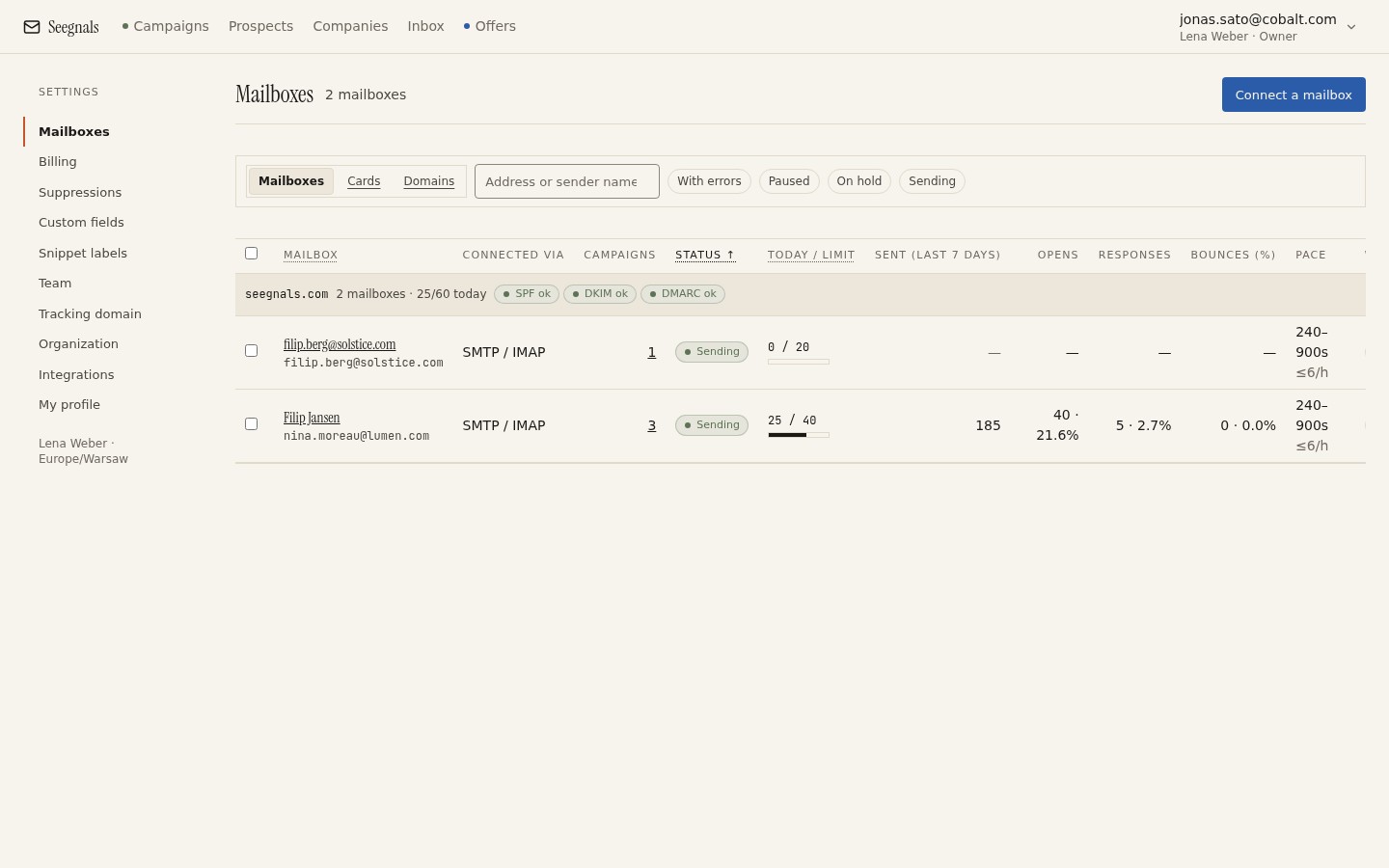 Each mailbox carries its own limit; a campaign spreads the day’s sends across them and keeps every prospect on the mailbox that first wrote to them.
One honest note: warm-up, the practice of gradually raising a new mailbox’s volume, is something you should do for any fresh domain. Seegnals does not do it for you yet; a partner integration is listed as coming soon. Plan for it separately.
Decision four: how you follow up
Most replies to cold email come to a follow-up rather than to the first message.
Decide the shape of the sequence before the first send. A fixed number of steps, usually two to four after the opener, with delays of a few working days between them. Each step should add something: a different angle on the same problem, a short example, a direct question. A follow-up that says “just bumping this” adds nothing and costs goodwill. How many steps is enough is covered in how many follow-ups in a cold email sequence.
Follow-ups should stay in the same thread, from the same mailbox, so the reader sees one conversation rather than four unrelated emails. A campaign that rotates mailboxes must still keep each prospect on the mailbox it started with; that is how the thread survives rotation.
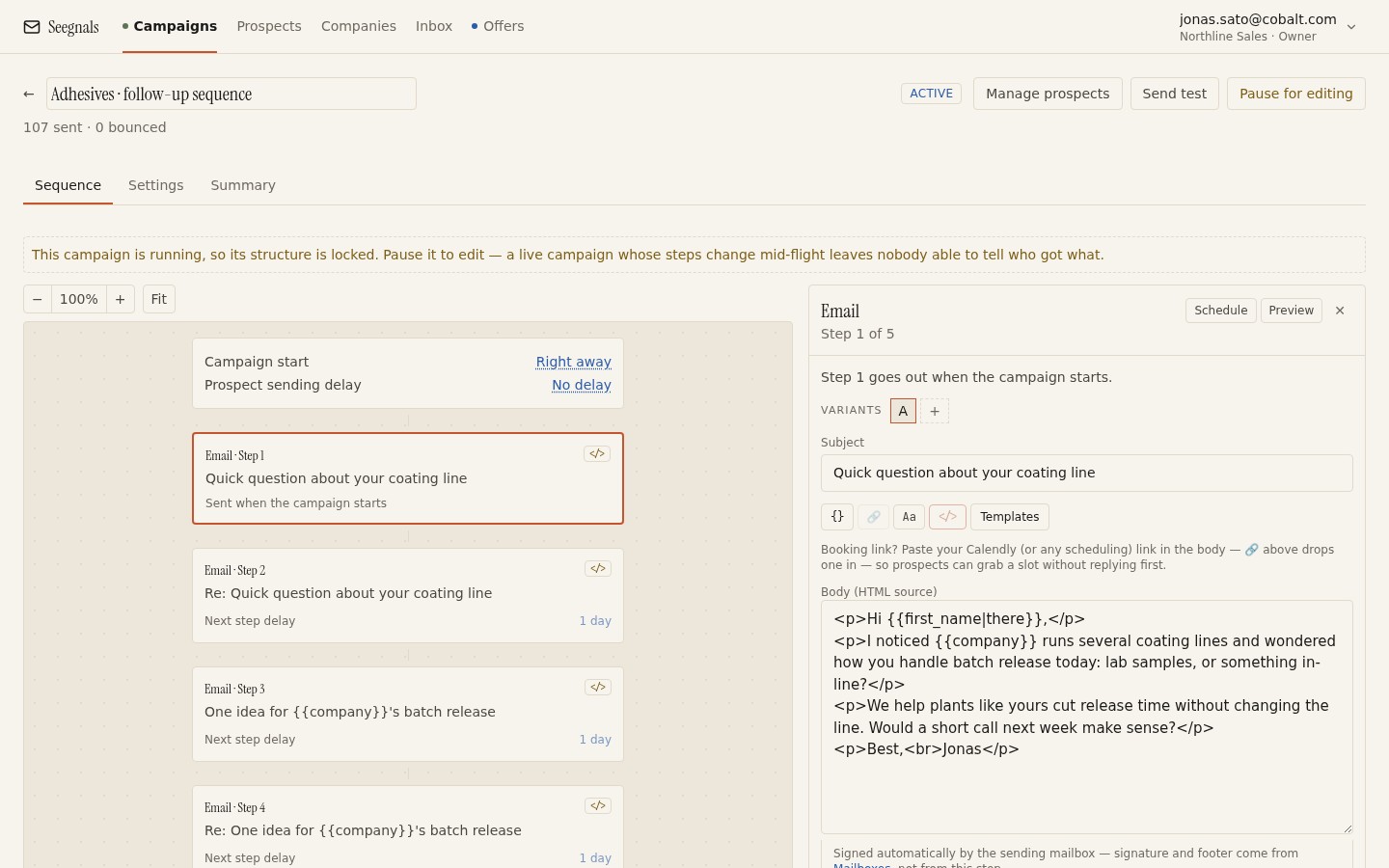 The sequence is decided once, before the first send: how many steps, how many days apart, and what each one adds.
Sending windows matter here too. Set weekdays and hours per campaign and apply them in each prospect’s own timezone, so a follow-up does not arrive at four in the morning because your team is two time zones away.
Decision five: what happens when someone replies
The reply is the output. The reply is the number that matters. And every reply, including the ones that say no, tells you something about the list and the message.
Decide in advance what happens to each kind. An interested reply stops the sequence for that person and starts a conversation; the other people at the same company should probably pause too, because you now have a way in. A “maybe later” gets a date and a note. A “not interested” from the person who owns the decision stops the account. An autoreply or out-of-office is not a reply at all and should not change anything except perhaps a delay. A bounce is a data problem and goes back into the list. An unsubscribe request goes onto the suppression list, immediately, by address and usually by domain.
Doing this by hand across several mailboxes is where small teams lose replies. An inbox that pulls every connected mailbox into one place and sorts replies automatically into Interested, Maybe later, Not interested, Autoreply, Bounce, Unsubscribe request and Other, with the company’s history beside the thread, turns a chore into a ten-minute morning routine. A classified reply stops the sequence for that person; you reclassify with one click when the sorter gets it wrong. The routine is described in sorting replies: interested, maybe later, not now.
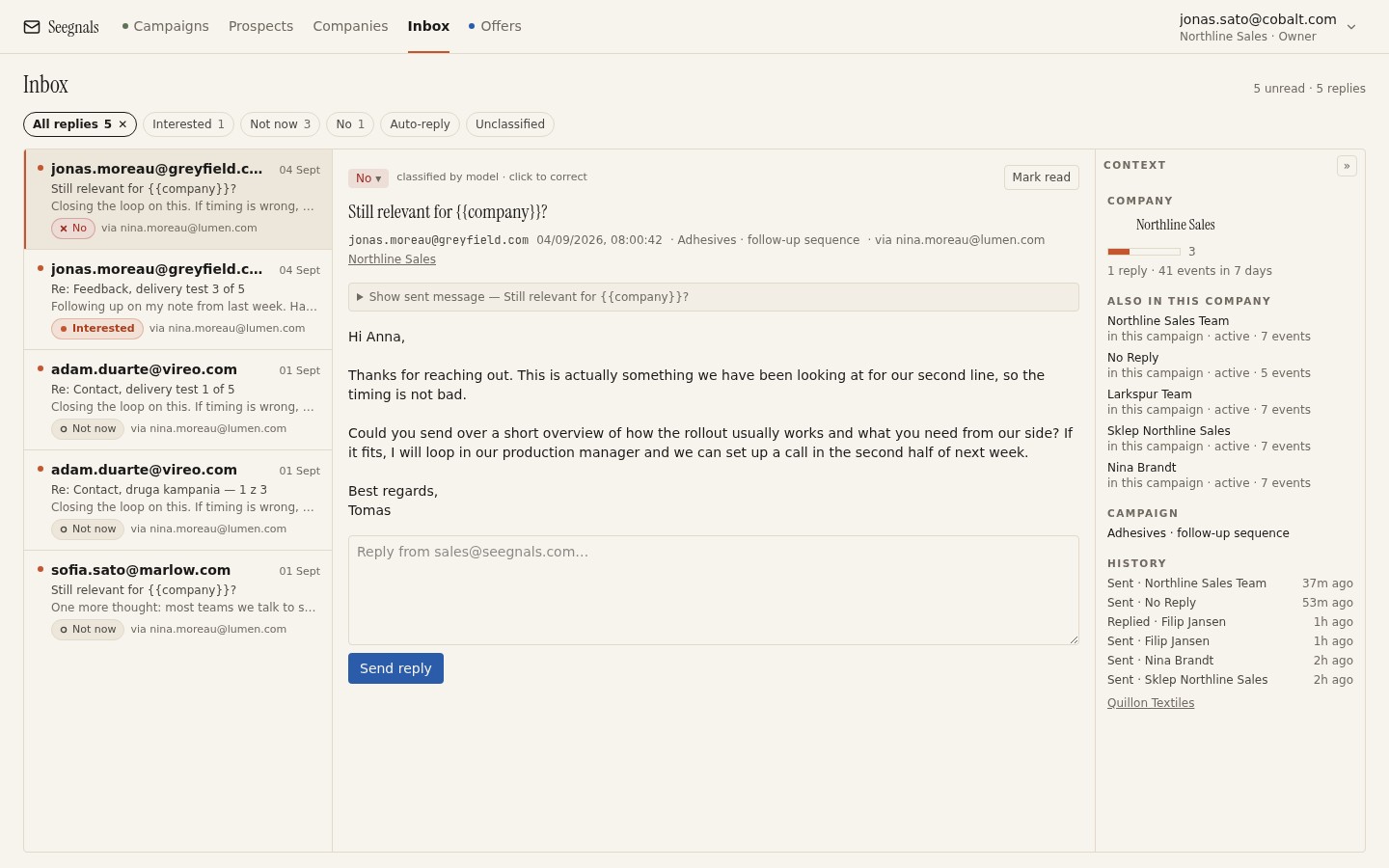 Every reply from every mailbox lands in one list, already sorted, with the company’s timeline next to it so you know who else there has seen your emails.
The last thing to say about replies is about measurement. Reply rate on its own tells you very little; a campaign with fewer replies but more of them from the right companies is the better campaign. Reply rate is the wrong north star makes the case for counting interested companies instead.
Why the order matters
If you start with the template, you end up polishing words for a list that does not share a problem. If you start with the mailbox, you end up with a perfectly authenticated domain sending nothing anyone wants. If you start with follow-ups, you write four emails before you know whether the first one is right.
The order also tells you where to look when a campaign underperforms. Low delivery is a mailbox problem. Delivery fine but nobody replies is a list or message problem, and the list is the more likely culprit. Replies but all of them polite refusals is a message problem, usually the ask. Replies you never saw is a process problem at step five.
What to do this week
- Write your segment in one sentence with checkable facts. If you cannot, spend the week on that and nothing else.
- Build a list of thirty to fifty companies in that segment, two or three people each by role, and run it through verification before it touches a campaign.
- Check SPF, DKIM and DMARC on your sending domain, set a daily limit per mailbox that you would be comfortable holding for a month, and connect at least two mailboxes.
- Write the first message and two follow-ups, each adding one new thing, with a small interest-based ask at the end of each.
- Write down, in a few lines, what happens to a company on interested, maybe later, not interested, autoreply, bounce and unsubscribe. Then launch and read every reply for a week before changing anything.